Life Insurance for Seniors After a Heart Attack: Your Complete Guide (2026)

Surviving a heart attack changes everything. Beyond the physical recovery, you may be wondering whether life insurance is still possible. The good news is that life insurance for seniors after a heart attack is absolutely available, and this guide will show you exactly how to get it.
Every year, approximately 805,000 Americans experience a heart attack. The average age for heart attacks is 66 for men and 70 for women, which means many seniors face this exact situation. Understanding your options can help protect your family’s financial future even after a cardiac event. The big question is can you get life insurance after a heart attack?
Is Life Insurance for Seniors After a Heart Attack Possible?
Yes, life insurance for seniors after a heart attack is probable. While a heart attack does make you a higher-risk applicant, it does not automatically disqualify you from coverage. Many insurance companies specialize in working with seniors who have experienced cardiac events.
The key factors that determine your eligibility include how much time has passed since your heart attack, the severity of the event, your current health status, and whether you have made positive lifestyle changes. Insurance companies want to see stability and recovery before offering coverage.
Most insurers require a waiting period of 6 to 12 months after a heart attack before they will consider your application. Better rates typically become available 2 to 5 years after the event, depending on your recovery and follow-up care.
Types of Life Insurance Available After a Heart Attack
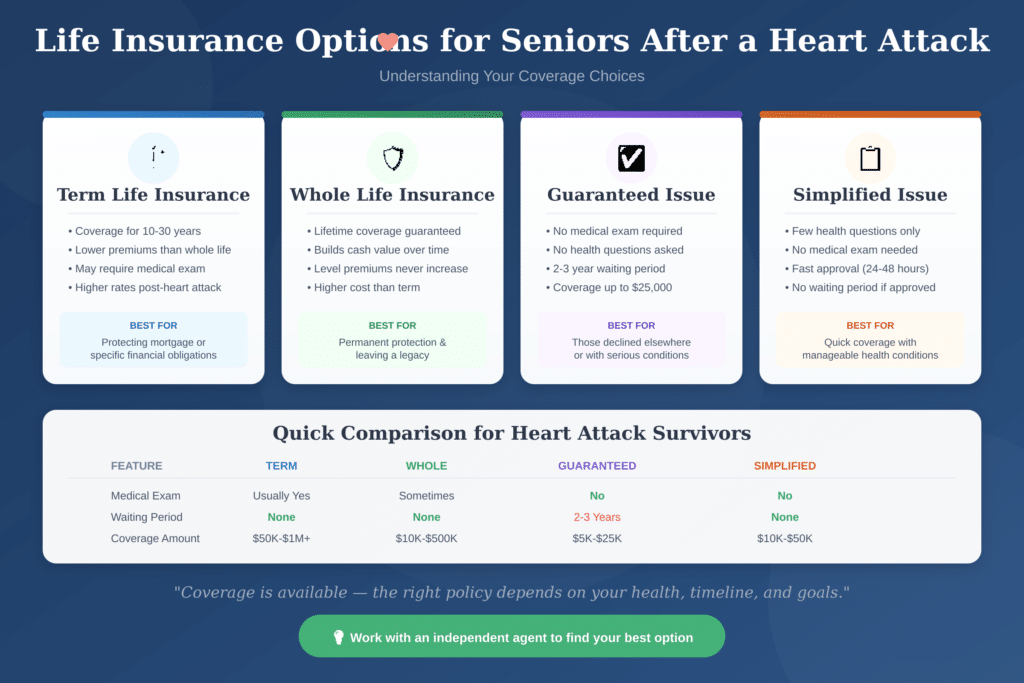
Seniors who have experienced a heart attack have several policy options to consider. Each type serves different needs and has different qualification requirements. What is the best life insurance after a heart attack?
Term Life Insurance provides coverage for a specific period, such as 10, 15, or 20 years. After a heart attack, you may still qualify for term coverage, though premiums will be higher than for someone without cardiac history. Term policies work well for seniors who need coverage to protect a specific financial obligation like a mortgage.
Whole Life Insurance offers permanent coverage that lasts your entire lifetime and includes a cash value component. Premiums remain level, and some policies are available without medical exams. This option suits seniors who want guaranteed lifetime protection.
Guaranteed Issue Life Insurance does not require medical exams or health questions. If you are between ages 50 and 85, acceptance is guaranteed. These policies typically offer coverage between $5,000 and $25,000 and are ideal for covering final expenses. However, they include a 2 to 3 year waiting period during which full benefits are not paid if death occurs from natural causes.
Simplified Issue Life Insurance requires answering a few health questions but no medical exam. Approval is usually faster than traditional policies. Coverage amounts and premiums fall between guaranteed issue and fully underwritten policies.
Insurance Companies That Work with Heart Attack Survivors
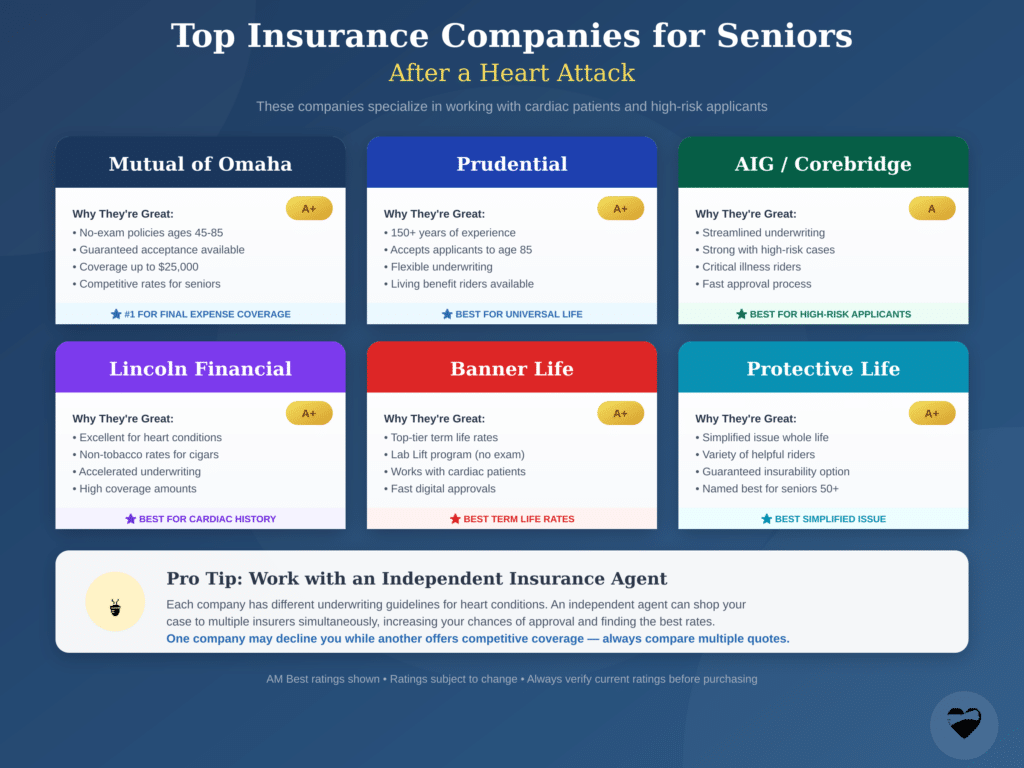
Not all insurance companies underwrite heart conditions the same way. The following companies have established reputations for working with seniors who have experienced heart attacks.
Mutual of Omaha consistently ranks as one of the best options for seniors with heart conditions. They offer no-medical-exam policies with guaranteed acceptance for ages 45 to 85. Their final expense insurance has no waiting period for qualified applicants and coverage up to $25,000. Mutual of Omaha received an A+ rating from AM Best and offers some of the most competitive rates in the industry.
Prudential has over 150 years of experience and accepts applicants up to age 85 for universal life policies. They offer flexibility for people who have experienced heart attacks and provide loyalty discounts for long-term customers. Prudential holds an A+ financial strength rating from AM Best.
AIG (Corebridge Financial) provides streamlined underwriting and accepts applications from seniors with cardiac history. They offer living benefit riders that allow access to death benefits if diagnosed with a critical or chronic illness. AIG has a strong track record with high-risk applicants.
Lincoln Financial is known for favorable underwriting with heart conditions and cancer histories. They offer both term and universal life products and accept applications from seniors with coronary artery disease history. Lincoln Financial provides nontobacco rates for cigar and pipe users.
Banner Life offers competitive rates and accelerated underwriting programs. They work with cardiac patients and have a Lab Lift program that may waive medical exams for applicants with recent lab work. Banner consistently ranks among the top companies for term life pricing.
Protective Life provides simplified issue whole life options with various riders for extra coverage. They accept applicants with heart conditions and offer a guaranteed insurability rider that lets you buy more insurance later without new underwriting.
Pacific Life, John Hancock, Nationwide, and SBLI also accept applications from seniors with heart attack history and may offer competitive rates depending on individual circumstances.
Sample Rate Charts for Seniors After a Heart Attack
Understanding potential costs helps you plan accordingly. The following charts show approximate monthly premiums for seniors after a heart attack. Life Insurance rates vary based on individual health factors, time since the event, and the specific insurance company.
Term Life Insurance Rates After Heart Attack (Estimated Monthly Premiums)
$100,000 Coverage – 10-Year Term
| Age | Male | Female |
|---|---|---|
| 60 | $180-$280 | $145-$225 |
| 65 | $250-$380 | $195-$295 |
| 70 | $380-$550 | $290-$420 |
| 75 | $550-$800 | $420-$600 |
$250,000 Coverage – 10-Year Term
| Age | Male | Female |
|---|---|---|
| 60 | $420-$650 | $340-$520 |
| 65 | $580-$880 | $450-$680 |
| 70 | $880-$1,250 | $670-$950 |
Note: These rates assume the heart attack occurred more than 2 years ago with stable recovery. Rates are higher for recent heart attacks or those with complications.
Guaranteed Issue Whole Life Insurance Rates (Estimated Monthly Premiums)
No Medical Exam Required – Coverage Up to $25,000
| Age | $10,000 Coverage | $15,000 Coverage | $25,000 Coverage |
|---|---|---|---|
| 60 | $45-$65 | $65-$95 | $105-$155 |
| 65 | $55-$80 | $80-$115 | $130-$190 |
| 70 | $70-$100 | $100-$145 | $165-$240 |
| 75 | $90-$130 | $130-$190 | $215-$310 |
| 80 | $115-$165 | $170-$245 | $280-$400 |
Note: Guaranteed issue policies have a 2-3 year waiting period. Death from natural causes during this period typically results in return of premiums plus interest rather than full death benefit.
Final Expense Insurance Rates with Health Questions (Estimated Monthly Premiums)
Simplified Issue – No Waiting Period for Approved Applicants
| Age | $10,000 Coverage | $20,000 Coverage |
|---|---|---|
| 60 | $35-$55 | $65-$105 |
| 65 | $45-$70 | $85-$135 |
| 70 | $60-$90 | $115-$175 |
| 75 | $80-$120 | $155-$235 |
| 80 | $105-$160 | $205-$315 |
Note: These rates assume heart attack occurred more than 4 years ago with stable health. Applicants must answer health questions and be approved.
Real-Life Examples of Life Insurance for Seniors after a Heart Attacks

Understanding how others have navigated this process can help you know what to expect. The following examples illustrate actual underwriting outcomes when buying life insurance for seniors after a heart attack.
Example 1: Robert, Age 65 Robert experienced a heart attack at age 62 and received two stents. Three years later, he wanted $250,000 in term coverage to protect his wife. His cardiologist confirmed excellent recovery with normal stress test results.
He took blood pressure and cholesterol medications as prescribed. An independent agent shopped his case to multiple carriers. Lincoln Financial and Prudential both offered coverage at Table 4 rates, meaning Robert paid approximately 100% more than standard rates. His monthly premium came to $285 for a 15-year term policy with $250,000 coverage.
Example 2: Margaret, Age 72 Margaret had a heart attack at 68 and wanted $15,000 in final expense coverage to pay for her funeral and medical bills. Because she had diabetes in addition to her heart history, traditional underwriting proved difficult.
She qualified for Mutual of Omaha’s simplified issue final expense policy at $95 per month. Her coverage had no waiting period because she answered health questions and was approved based on her stable condition.
Example 3: William, Age 60 William suffered a severe heart attack at 54 that damaged four arteries. He had bypass surgery and made significant lifestyle changes including losing 40 pounds and quitting smoking. At age 60, he needed $1,000,000 in coverage.
His agent submitted applications to multiple carriers. Eight companies declined him, but Lincoln Financial offered Table 4 rates. His monthly premium was $890 for a 20-year term policy. While expensive, the coverage provided essential protection for his family.
Example 4: Dorothy, Age 78 Dorothy experienced a mild heart attack at 74. At 78, she wanted coverage to help her children with final expenses. Most term policies were unavailable at her age.
She enrolled in AARP’s guaranteed acceptance life insurance for $10,000 in coverage at $125 per month. The policy had a 2-year waiting period, meaning full benefits would be paid after those first two years.
What Insurance Companies Look for During Underwriting
When you apply for life insurance for seniors after a heart attack, underwriters evaluate specific factors to determine your eligibility and rates.
Time Since the Heart Attack is critical. The longer ago your heart attack occurred, the better your chances of approval and lower rates. Most companies want at least 6 to 12 months of stability, but waiting 2 to 5 years often results in significantly better offers.
Severity of the Event matters significantly. A mild heart attack affecting a small portion of heart muscle is viewed more favorably than a massive heart attack that caused permanent damage. Underwriters look at how many arteries or vessels were affected.
Treatment Received influences your application. Whether you had stent placement, angioplasty, or bypass surgery affects how insurers view your case. Successful treatment with good outcomes improves your chances.
Current Heart Function is evaluated through test results. Your left ventricular ejection fraction (LVEF), stress test results, and echocardiogram findings help underwriters assess your current cardiac health. Normal or near-normal results significantly improve your prospects.
Other Health Conditions compound the risk assessment. Having diabetes, high blood pressure, obesity, or other conditions alongside heart attack history typically results in higher premiums or possible decline.
Lifestyle Factors can help or hurt your case. Smoking after a heart attack is a dealbreaker with most companies. Positive changes like regular exercise, healthy diet, and weight loss demonstrate commitment to your health and may improve offers.
Medications and Compliance show underwriters you take your health seriously. Following your doctor’s orders and taking prescribed medications as directed indicates stability and responsibility.

How to Improve Your Chances of Approval
Taking proactive steps can significantly improve your likelihood of getting approved for life insurance after a heart attack and potentially lower your premiums.
Wait the Appropriate Time before applying. Rushing to apply immediately after a heart attack usually results in decline or very high rates. Allow time for recovery and documentation of your stability.
Follow Your Doctor’s Orders diligently. Attend all follow-up appointments, take medications as prescribed, and complete cardiac rehabilitation if recommended. This creates a paper trail of responsible health management.
Gather Your Medical Records before applying. Request records from your cardiologist including stress test results, echocardiogram reports, and catheterization findings. Having these ready speeds up the process and demonstrates proactive engagement.
Quit Smoking Immediately if you have not already. Tobacco use after a heart attack is the single biggest obstacle to approval. The longer you remain tobacco-free, the better your rates.
Maintain a Healthy Weight and exercise regularly. Demonstrating commitment to heart-healthy habits improves your risk profile in underwriters’ eyes.
Work with an Independent Agent who specializes in high-risk cases. An experienced agent knows which companies are most favorable for cardiac patients and can shop your case to multiple insurers. This increases your chances of finding the best available offer.
Be Completely Honest on your application. Failing to disclose your heart attack or related conditions can result in claim denial later. Insurance companies access the Medical Information Bureau and prescription databases that reveal your health history.
Frequently Asked Questions
How long after a heart attack can I get life insurance?
Most insurance companies require a minimum waiting period of 6 to 12 months after a heart attack. However, you may receive better rates if you wait 2 to 5 years, allowing time to demonstrate stable recovery. Some guaranteed issue policies have no waiting period for acceptance, though they include a 2 to 3 year period before full benefits are paid.
Will I pay more for life insurance after a heart attack?
Yes, life insurance premiums are typically higher after a heart attack. Depending on your health profile and the time elapsed since your event, you may pay 50% to 200% more than someone without cardiac history. The exact increase depends on severity, recovery, other health conditions, and which company you apply with.
Can I get life insurance if I had bypass surgery?
Yes, life insurance after bypass surgery is possible. Underwriters will evaluate the number of vessels bypassed, your recovery, current heart function, and time since surgery. Many applicants with bypass history qualify for coverage at table ratings between Table 2 and Table 6, meaning 50% to 150% above standard rates.
What is guaranteed issue life insurance?
Guaranteed issue life insurance accepts all applicants regardless of health status. These policies require no medical exam and no health questions. Coverage amounts typically range from $5,000 to $25,000. The tradeoff is higher premiums and a waiting period of 2 to 3 years during which full benefits are not paid for natural death.
Should I get term or whole life insurance after a heart attack?
The choice depends on your needs and budget. Term insurance costs less but expires after the term ends. Whole life insurance provides permanent coverage and builds cash value but costs more. Many seniors after a heart attack choose whole life or final expense coverage for its permanence and guaranteed acceptance options.
What if I already have life insurance and then have a heart attack?
If you already have a life insurance policy before experiencing a heart attack, your coverage remains in effect. Your premiums will not increase, and your policy cannot be canceled due to changes in health after the policy is issued. This is why purchasing coverage before health events occur is always recommended.
Which company is best for life insurance after a heart attack?
The best company depends on your specific situation. Mutual of Omaha, Prudential, AIG (Corebridge), Lincoln Financial, and Banner Life all have favorable underwriting for cardiac patients. Working with an independent agent who can compare offers from multiple companies gives you the best chance of finding optimal coverage at competitive rates.
Can I be denied life insurance because of a heart attack?
Yes, some companies may decline your application, especially if your heart attack was recent, severe, or you have multiple health conditions. However, denial from one company does not mean all will decline you. Guaranteed issue policies cannot deny you for any health reason. Shopping multiple companies through an independent agent maximizes your approval chances.
How much life insurance do I need after a heart attack?
The amount depends on your financial obligations. Consider outstanding debts, mortgage balance, final expenses, and income replacement for your spouse. Many financial advisors recommend 8 to 10 times your annual income. For seniors focused primarily on final expenses, $10,000 to $25,000 typically covers funeral costs and related bills.
Do I need a medical exam for life insurance after a heart attack?
Not necessarily. Simplified issue and guaranteed issue policies do not require medical exams. However, policies requiring exams often offer lower premiums for qualified applicants. Your agent can help determine whether exam or no-exam policies better suit your situation.
Taking the Next Step
Life insurance for seniors after a heart attack provides essential financial protection for your family. While your options and rates may differ from someone without cardiac history, coverage is available from many reputable insurance companies.
The most important step is working with an experienced independent agent who understands high-risk underwriting. They can evaluate your specific health situation, identify the most favorable companies for your profile, and help you secure the best available coverage.
Do not let a heart attack stop you from protecting your loved ones. With the right approach and guidance, you can find affordable life insurance that provides peace of mind for you and security for your family.