Life Insurance for Seniors on Blood Thinners: Your Complete 2026 Guide
If you’re a senior taking blood thinners — whether that’s warfarin, Eliquis, Xarelto, or another anticoagulant — you may have heard that getting life insurance is complicated or even impossible. The good news? That’s simply not true.
Life insurance for seniors on blood thinners is available, and many people in this situation qualify for solid coverage at reasonable rates. What matters most to insurers isn’t the medication itself — it’s why you’re taking it and how well your condition is managed.
In this guide, we’ll walk you through everything you need to know: how underwriters evaluate anticoagulant use, which policy types tend to work best for seniors on blood thinners, what to expect during the application process, and how to maximize your chances of getting approved at a fair premium.
Why Blood Thinners Raise Questions for Life Insurance Underwriters
First, let’s clear something up: being on blood thinners doesn’t automatically disqualify you from life insurance. Insurance underwriters aren’t afraid of the medication itself. What they’re really evaluating is the underlying health condition that led to the prescription.
Anticoagulants are prescribed for a wide range of heart conditions — some more serious than others. Common reasons seniors are placed on blood thinners include:
- Atrial fibrillation (AFib)
- Deep vein thrombosis (DVT) or pulmonary embolism (PE)
- Mechanical heart valves
- History of stroke or TIA (mini-stroke)
- Peripheral artery disease (PAD)
- Certain clotting disorders
- Multiple Heart Attacks
Each of these conditions carries its own level of risk in the eyes of an underwriter. Someone on Eliquis for AFib with an otherwise healthy profile is a very different applicant from someone with a recent stroke and multiple comorbidities.
The key takeaway: the medication is a flag, not a death sentence for your application. How your doctor manages your condition — and how stable your health has been — matters far more than the drug on your prescription list.
Available Life Insurance for Seniors on Blood Thinners?

The right policy for you depends largely on your overall health, age, and what you need coverage to accomplish. Here’s a breakdown of the main options for seniors:
1. Term Life Insurance
Term life offers the most coverage for the lowest cost — but it requires full medical underwriting. For seniors on blood thinners with a well-controlled condition (like stable AFib), term life is absolutely on the table, especially for those under 70 in otherwise decent health.
Expect the insurer to order your medical records, possibly require a paramedical exam, and review your history of INR levels, hospitalizations, and specialist visits. If everything looks stable, you may still qualify at standard or slightly elevated rates.
2. Whole Life Insurance
Whole life provides permanent, lifelong coverage and builds cash value over time. Like term, it requires underwriting for traditionally issued policies. Seniors on blood thinners who are otherwise in good health may qualify. Premiums are higher than term, but the policy never expires.
3. Final Expense Insurance (Burial Insurance)
Final expense insurance is one of the most accessible options for seniors on blood thinners. These are small whole life policies — typically $5,000 to $25,000 — designed to cover funeral costs, medical bills, and other end-of-life expenses.
Many final expense insurers use simplified underwriting — meaning they ask health questions but don’t require a full medical exam. Depending on the insurer and your specific health history, you may qualify for:
- Level benefit (immediate full coverage) — for well-managed conditions
- Graded benefit (partial payout in first 2 years) — for higher-risk applicants
- Modified benefit — similar to graded but sometimes with different terms
Final expense insurance is an excellent safety net for seniors on blood thinners who may struggle to qualify for larger, fully underwritten policies.
4. Guaranteed Issue Life Insurance
Guaranteed issue (GI) policies ask no health questions whatsoever. If you’re within the eligible age range (typically 50–85), you cannot be turned down. This makes guaranteed issue the last resort for life insurance for seniors on blood thinners and with serious additional health conditions.
The trade-off: coverage amounts are small (usually $5,000–$25,000), premiums are higher relative to the benefit, and most policies have a 2-year waiting period before the full death benefit kicks in. That said, for someone who has been declined elsewhere, it’s a meaningful option.
5. Group Life Insurance
If you’re still working or belong to an organization that offers group life insurance, this can be a backdoor into coverage without individual underwriting. Group plans typically don’t require medical exams and may offer guaranteed enrollment during open periods — a significant advantage for seniors on blood thinners.
How Insurers Evaluate Seniors on Blood Thinners: The Underwriting Process

Understanding how life insurance underwriting works can help you go into the application process with realistic expectations — and better preparation.
When an underwriter reviews an application for life insurance for seniors on blood thinners, they typically want to know:
- The specific condition requiring anticoagulation therapy
- How long you’ve been on the medication
- Current INR levels or other relevant labs (for warfarin users especially)
- Whether the condition is stable or has recently worsened
- Any hospitalizations or ER visits related to the condition in the past 3–5 years
- Other co-existing health conditions (diabetes, kidney disease, COPD, etc.)
- Your current age, weight, and tobacco use status
For well-managed conditions like AFib, a senior who has been on Eliquis for several years, sees their cardiologist regularly, and has no recent hospitalizations may receive a standard rating — meaning they pay the same as someone without the condition.
More complex situations — such as a recent blood clot, multiple strokes, or heart failure alongside AFib — will typically result in a table rating (a premium surcharge) or a decline from traditional underwriters. In those cases, final expense or guaranteed issue coverage becomes the better path.
Common Blood Thinners and How Insurers View Them
Not all blood thinners are treated equally by life insurance underwriters. Here’s a general overview:
| Medication | Common Use | Underwriting Outlook |
| Warfarin (Coumadin) | AFib, DVT, mechanical valves | Closely scrutinized; stable INR range is key |
| Eliquis (apixaban) | AFib, DVT prevention | Generally viewed favorably if condition is well-managed |
| Xarelto (rivaroxaban) | AFib, DVT/PE treatment | Similar to Eliquis; depends on underlying diagnosis |
| Pradaxa (dabigatran) | AFib, DVT prevention | Similar underwriting approach to other NOACs |
| Plavix (clopidogrel) | Heart disease, stents | Depends heavily on the cardiac event history |
| Aspirin (therapeutic) | Cardiovascular prevention | Least impactful; often rated standard |
Tips for Seniors on Blood Thinners Applying for Life Insurance
A few smart moves can meaningfully improve your chances of approval — and help you get a better rate:

1. Work with an independent insurance agent. Independent agents can shop your profile across dozens of insurers rather than locking you into one company’s underwriting guidelines. Different insurers have very different views of the same condition — one company’s decline can be another’s standard approval.
2. Get your medical records in order. Before you apply, request copies of your recent doctor’s notes, lab results, and specialist reports. Know your INR history, your last echocardiogram or Holter monitor results, and any other relevant tests. Being prepared speeds things up and reduces surprises.
3. Be completely honest on your application. Misrepresenting your health history is considered fraud and can result in a denied claim — leaving your family with nothing. Full transparency is not just the ethical choice; it’s the legally required one.
4. Don’t apply to multiple companies simultaneously. Every application creates an inquiry on your insurance record (MIB report). Multiple applications in a short window can raise red flags. Instead, have your agent shop informally before formally submitting.
5. Time your application wisely. If you’ve recently had a blood clot, hospitalization, or medication change, waiting 6–12 months for your health to stabilize can lead to significantly better rates. Ask your agent about optimal timing given your history.
6. Consider layering coverage. You don’t have to put all your eggs in one basket. A smaller final expense policy combined with a term or whole life policy can give you solid overall coverage even if you don’t qualify for a large fully underwritten policy.
What is the Cost of Life Insurance for Seniors on Blood Thinners?
Premiums vary widely based on your age, health, coverage amount, and the type of policy. That said, here are realistic ballpark figures to set expectations:
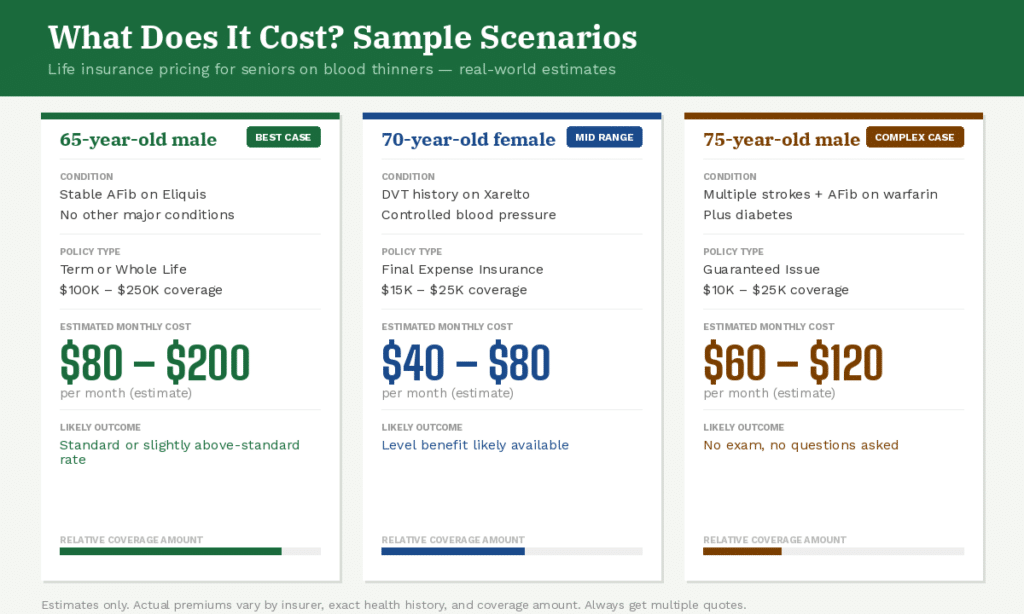
Scenario: 65-year-old male, stable AFib on Eliquis, no other major conditions — May qualify for standard or slightly above-standard rates on a $100,000–$250,000 term or whole life policy. Monthly premiums could range from $80–$200 depending on the carrier.
Scenario: 70-year-old female, DVT history on Xarelto, controlled blood pressure — Likely qualifies for final expense insurance at level benefit rates. Could secure $15,000–$25,000 in coverage for $40–$80/month.
Scenario: 80-year-old male, multiple strokes, AFib, diabetes — on warfarin — Traditional underwriting may be a challenge. Guaranteed issue coverage of $10,000–$25,000 is likely the most accessible path, with premiums of $60–$120/month.
The bottom line: life insurance for seniors on blood thinners is obtainable at many health profiles. The key is matching your specific situation to the right product and carrier.
What If You’ve Been Declined?
A decline from one insurer is not the end of the road. Here’s what to do:
- Ask for the specific reason for the decline — you’re entitled to know.
- Request your MIB (Medical Information Bureau) report to check for errors.
- Have an independent agent review your profile and identify more favorable carriers.
- Consider final expense insurance or guaranteed issue coverage if traditional underwriting keeps declining you.
- Revisit in 12–24 months if your health situation improves.
Many seniors who were declined elsewhere have gone on to secure meaningful life insurance coverage through the right channel and the right insurer. Don’t give up after one rejection.
Frequently Asked Questions (FAQ)
Can seniors on blood thinners get life insurance?
Yes. Life insurance for seniors on blood thinners is available through multiple policy types, including term life, whole life, final expense, and guaranteed issue policies. The key factor is the underlying condition requiring anticoagulation and how well it is managed.
Does taking blood thinners disqualify you from life insurance?
No, blood thinners alone do not disqualify you. Underwriters look at the reason for the prescription, your overall health history, and condition stability. Many seniors on anticoagulants are approved at standard or mildly elevated rates.
What is the best type of life insurance for seniors on blood thinners?
The best type of life insurance for seniors on blood thinners depends on your health. Seniors with well-controlled conditions may qualify for term or whole life insurance. Those with more complex histories often do better with final expense insurance or guaranteed issue life insurance, which have less strict underwriting.
Does life insurance cost more if you take Eliquis or warfarin?
It may, depending on the underlying condition. Taking Eliquis for well-managed AFib may result in little to no premium increase. More serious conditions like a recent stroke or uncontrolled heart disease will typically result in higher premiums or limited coverage options
What is final expense insurance and is it good for blood thinner users?
Final expense insurance is a small whole life policy designed to cover burial and end-of-life costs. It uses simplified underwriting (health questions but no exam), making it one of the most accessible options for seniors on blood thinners.
Is guaranteed issue life insurance a good option for seniors on blood thinners?
Guaranteed issue life insurance is a strong option for seniors who have been declined by other policies. It requires no health questions and cannot deny coverage based on medical history, though it comes with lower benefit amounts and a 2-year waiting period.
Can you get life insurance after a blood clot on blood thinners?
Yes, but timing matters. Many insurers require at least 12 months of stability after a DVT or pulmonary embolism before offering favorable rates on a fully underwritten policy. Final expense and guaranteed issue policies may be available sooner.
How do I find the best life insurance company for someone on blood thinners?
Work with an independent life insurance agent who can shop your profile across multiple carriers. Each insurer has different underwriting guidelines for anticoagulant use, and an independent agent can identify which companies view your specific condition most favorably.
The Bottom Line: Life Insurance Is Within Reach
Life insurance for seniors on blood thinners is not a pipe dream — it’s a very real possibility for most applicants. Whether you’re managing AFib with Eliquis, recovering from a DVT, or dealing with a more complex cardiac history, there is likely a policy type and a carrier that works for your situation.
The smartest first step is to consult with an independent life insurance agent who specializes in high-risk or senior applicants. They can evaluate your health profile, identify the carriers most likely to work in your favor, and walk you through the application process with confidence.
Don’t let a prescription list stand between your family and the financial protection they deserve. With the right guidance, life insurance for seniors on blood thinners is not just possible — it’s often more affordable and accessible than most people expect.
Ready to find out what you qualify for? Get a free, no-obligation quote today and let a licensed agent match you with the right coverage for your needs.