Life Insurance for Seniors with Kidney Disease: What You Need to Know (2026 Guide)
 Posted in Final Expense Life Insurance on June 8, 2026 last updated on June 8, 2026
Is Life Insurance for Seniors with Kidney Disease Possible?
Yes. Many seniors with kidney disease can still qualify for life insurance with no waiting period.
The type of policy you qualify for depends on several factors, including the stage of kidney disease, whether you’re on dialysis, transplant history, diabetes, high blood pressure, heart disease, and your overall health.
Many people assume a diagnosis of chronic kidney disease (CKD) automatically means they cannot get coverage. Fortunately, that’s not true. While kidney disease can affect approval and pricing, there are still several life insurance options available—even for applicants with advanced kidney disease.
Whether you have Stage 2 CKD, Stage 3 kidney disease, are receiving dialysis treatments, or have undergone a kidney transplant, there may be companies willing to offer coverage.
Understanding Kidney Disease and Life Insurance
Kidney disease occurs when the kidneys lose their ability to effectively filter waste and excess fluids from the blood.
According to the National Kidney Foundation, chronic kidney disease affects millions of Americans, particularly seniors.
Insurance companies evaluate kidney disease because severe kidney impairment is associated with increased health risks, including:
- Heart disease
- Stroke
- High blood pressure
- Diabetes complications
- Increased mortality risk
However, insurance companies do not evaluate all kidney disease cases equally.
A senior with mild, stable Stage 2 CKD is viewed very differently than someone receiving dialysis treatments multiple times per week.
The key is understanding how insurers evaluate risk.
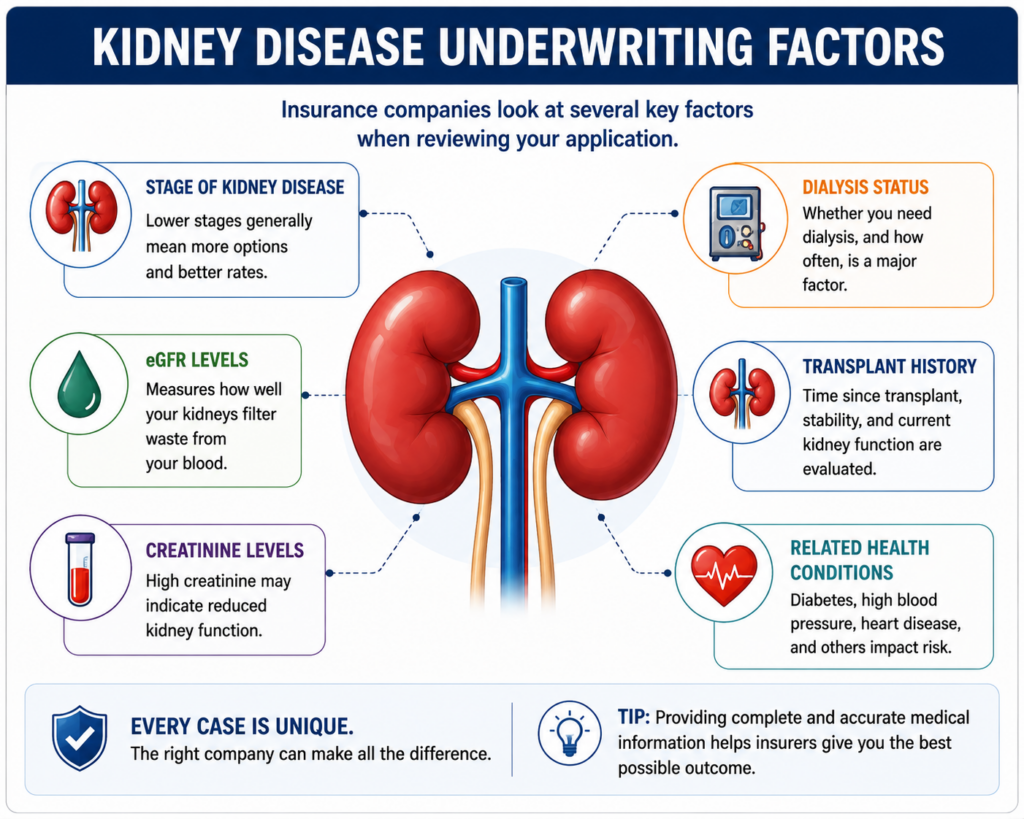
How Insurance Companies Evaluate Kidney Disease
When you apply for life insurance, underwriters review several factors:
1. Stage of Kidney Disease
The stage of your CKD is usually the most important factor.
The lower the stage, the more favorable your options generally become.
2. eGFR Levels
Estimated Glomerular Filtration Rate (eGFR) measures kidney function.
Higher numbers generally indicate healthier kidneys.
3. Creatinine Levels
Creatinine is a waste product filtered by the kidneys.
Elevated levels may indicate reduced kidney function.
4. Dialysis Status
Insurance companies carefully evaluate:
- Whether dialysis is required
- Frequency of treatment
- Length of time on dialysis
5. Kidney Transplant History
Applicants who have received a kidney transplant may still qualify depending on:
- How long ago the transplant occurred
- Current kidney function
- Stability of health
6. Related Health Conditions
Kidney disease frequently occurs alongside:
- Diabetes
- High blood pressure
- Heart disease
- Obesity
- Smoking history
The combination of conditions often affects underwriting more than kidney disease alone.
What Underwriting Class Can You Qualify For With Kidney Disease?
One of the most common questions seniors ask is whether kidney disease automatically results in a decline or a high-risk rating.
The answer depends on the severity of the condition and how well it is managed.
In general:
| Kidney Disease Severity | Possible Underwriting Outcome |
|---|---|
| Stage 1 CKD | Standard Plus to Standard |
| Stage 2 CKD | Standard to Table Rated |
| Stage 3 CKD | Table Rated |
| Stage 4 CKD | Simplified Issue or Final Expense |
| Stage 5 CKD / Dialysis | Guaranteed Issue or Final Expense |
Insurance companies also evaluate:
- eGFR trends over time
- Medication compliance
- Diabetes management
- Blood pressure control
- Smoking history
- Hospitalizations
Applicants who demonstrate stable kidney function and good overall health often receive significantly better offers than those with recent complications.
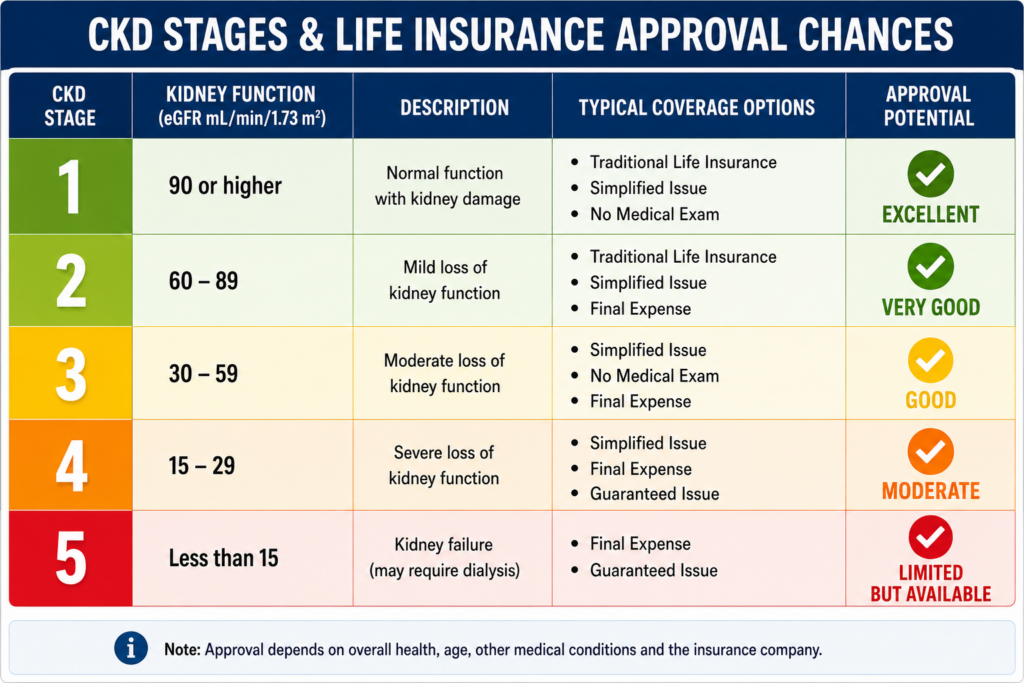
Stage 1 Kidney Disease
Stage 1 CKD involves normal kidney function with minor evidence of kidney damage.
Typical Underwriting Outcome
Many applicants qualify for:
- Traditional life insurance
- Simplified issue coverage
- No-medical-exam policies
Approval Potential
Excellent
Stage 2 Kidney Disease
Stage 2 CKD involves mild kidney function decline.
Many seniors remain eligible for standard coverage options.
Typical Coverage Options
- Traditional underwriting
- Simplified issue
- Final expense
Approval Potential
Very Good
Stage 3 Kidney Disease
Stage 3 CKD is one of the most common stages among seniors.
Many applicants still obtain life insurance successfully.
Coverage Options
- Simplified issue
- No-medical-exam life insurance
- Final expense insurance
Approval Potential
Good
Premiums may increase, but coverage is still widely available.
Stage 4 Kidney Disease
Stage 4 CKD indicates severe loss of kidney function.
Insurance companies become more cautious.
Typical Options
- Simplified issue
- Final expense
- Guaranteed issue
Approval Potential
Moderate
Stage 5 Kidney Disease
Stage 5 CKD is considered kidney failure.
Applicants often require dialysis.
Coverage Options
- Final expense insurance
- Guaranteed issue life insurance
Approval Potential
Limited but available
Can You Get Life Insurance While on Dialysis?
Yes.
Many seniors on dialysis believe they are completely uninsurable.
While traditional life insurance becomes difficult to obtain, other options remain available.
Common Options
- Guaranteed issue life insurance
- Final expense insurance
- Certain simplified issue products
Coverage amounts may be lower, but protection is still available.
Can Kidney Transplant Patients Get Life Insurance?
Absolutely.
A kidney transplant does not automatically prevent approval.
Insurance companies typically want to see:
- Successful transplant outcome
- Stable kidney function
- Consistent follow-up care
- No recent complications
Applicants who demonstrate long-term stability often have better options than individuals currently receiving dialysis.
Best Life Insurance Options for Seniors with Kidney Disease
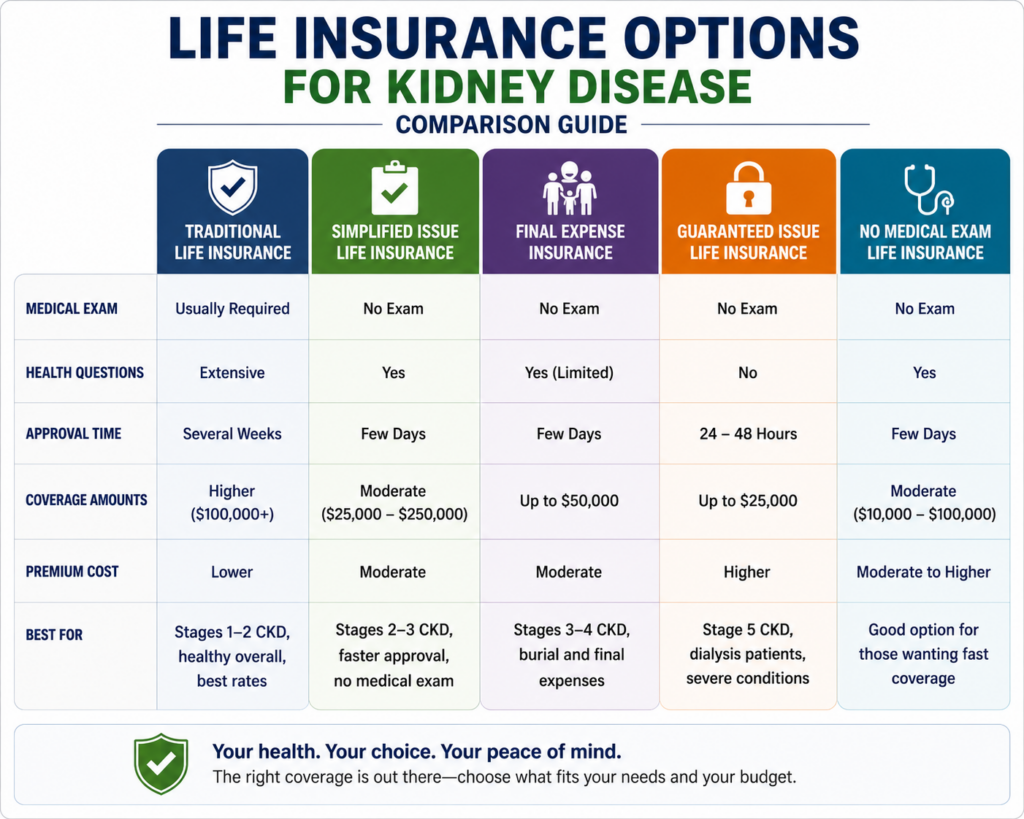
Traditional Life Insurance such as term life or whole life.
Best for:
- Stage 1 CKD
- Stage 2 CKD
- Stable Stage 3 CKD
Advantages
- Lower premiums
- Higher coverage amounts
- Better underwriting classes
Disadvantages
- Medical exam often required
- Longer approval process
Simplified Issue Life Insurance
Best for:
- Stage 2 CKD
- Stage 3 CKD
- Seniors wanting faster approval
Advantages
- No medical exam
- Quick approval
- Coverage available within days
Disadvantages
- Higher premiums
- Health questions required
No Medical Exam Life Insurance
Many carriers now use electronic medical records instead of exams.
Advantages
- Fast approval
- No bloodwork
- No urine testing
Disadvantages
- Not available for every health situation
Final Expense Insurance
One of the most popular choices for seniors with kidney disease is final expense insurance.
Advantages
- Easier approval
- Lifetime coverage
- Fixed premiums
Best For
- Stage 3 CKD
- Stage 4 CKD
- Multiple health conditions
Guaranteed Issue Life Insurance
Guaranteed issue policies ask no health questions.
Advantages
- Cannot be declined due to health
- Fast approval
- No medical exam
Disadvantages
- Higher cost
- Lower coverage amounts
- Graded death benefit period
Life Insurance With Kidney Disease and Diabetes
Diabetes is one of the leading causes of chronic kidney disease.
When diabetes and kidney disease occur together, insurance companies typically review:
- A1C levels
- Insulin use
- Kidney function
- Neuropathy
- Retinopathy
- Cardiovascular history
While approval may be more challenging, many seniors with both diabetes and kidney disease still qualify for life insurance.
The key is choosing a company that has favorable underwriting guidelines for both conditions.
If you have diabetes, you may also want to review our guide to Life Insurance for Seniors with Diabetes.
Mutual of Omaha
Mutual of Omaha remains one of the strongest options for seniors seeking final expense coverage.
Best For
- Moderate health conditions
- Final expense insurance
- Fast underwriting
Foresters Financial
Foresters offers competitive simplified issue products.
Best For
- Seniors seeking no-medical-exam coverage
- Faster approval
Americo
Americo is often competitive for applicants with multiple medical conditions.
Best For
- Stage 3 CKD
- Final expense insurance
AIG
AIG remains a strong guaranteed issue provider.
Best For
- Severe kidney disease
- Dialysis patients
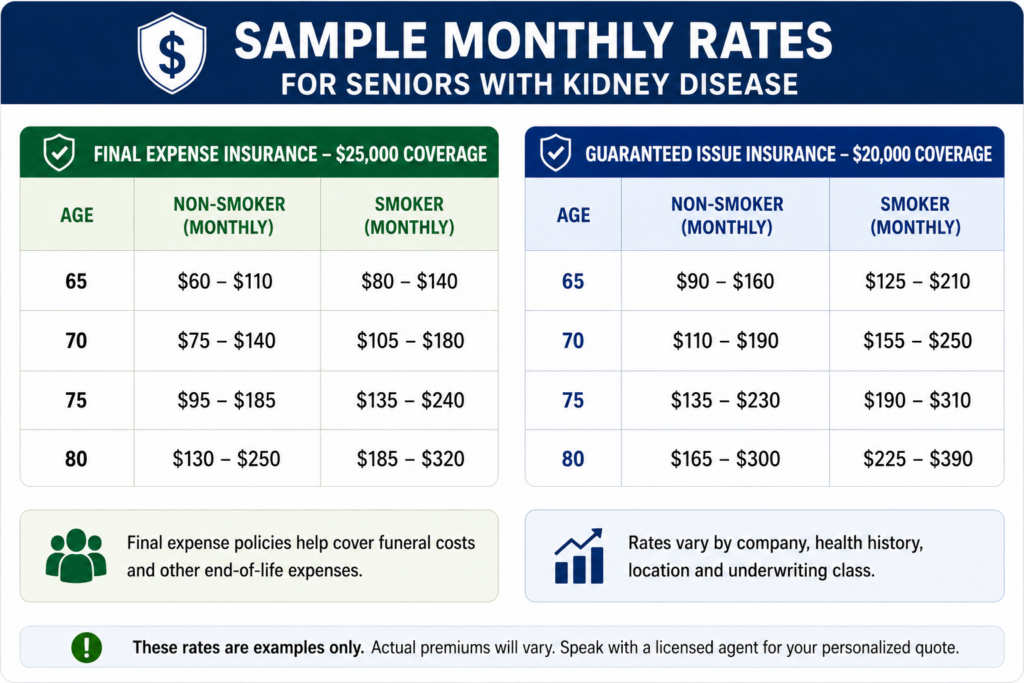
Sample Monthly Rates
The examples below are illustrations only.
Actual premiums vary by age, gender, health history, tobacco use, and underwriting class.
Sample Final Expense Rates
| Age | Coverage | Estimated Monthly Premium |
|---|---|---|
| 65 | $25,000 | $60-$110 |
| 70 | $25,000 | $75-$140 |
| 75 | $25,000 | $95-$185 |
| 80 | $25,000 | $130-$250 |
Sample Guaranteed Issue Rates
| Age | Coverage | Estimated Monthly Premium |
|---|---|---|
| 65 | $20,000 | $90-$160 |
| 70 | $20,000 | $110-$190 |
| 75 | $20,000 | $135-$230 |
| 80 | $20,000 | $165-$300 |
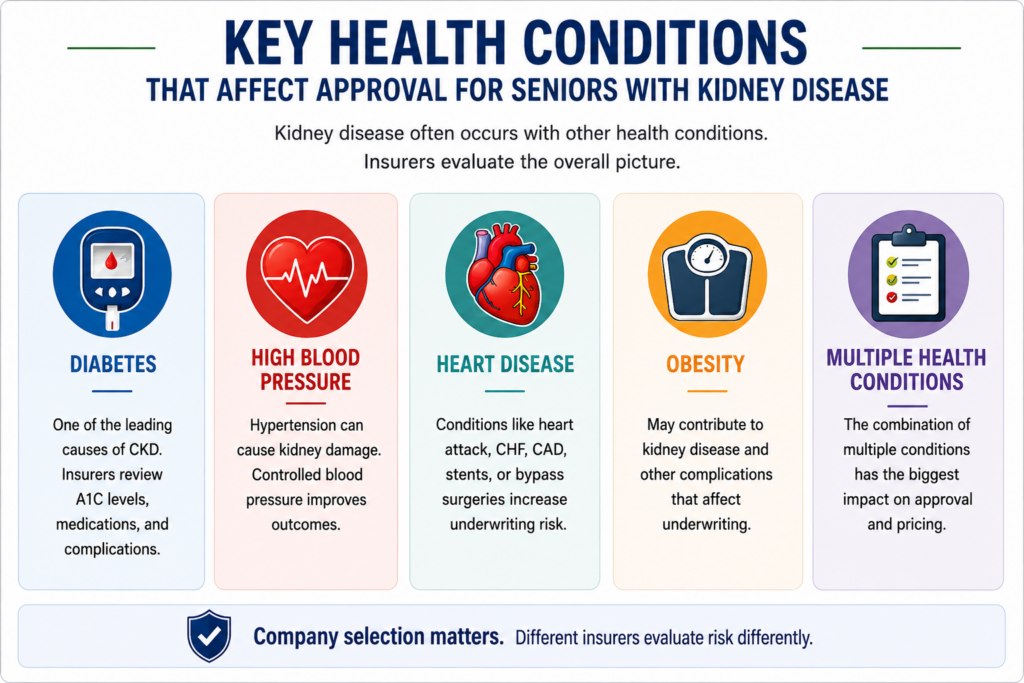
How Other Health Conditions Affect Approval
Kidney disease rarely exists by itself.
Insurance companies frequently evaluate combinations of conditions.
Diabetes and Kidney Disease
Diabetes is one of the leading causes of CKD.
Insurance companies often review:
- A1C levels
- Medication use
- Complications
High Blood Pressure
Hypertension contributes significantly to kidney damage.
Controlled blood pressure generally improves underwriting outcomes.
Heart Disease
Heart disease combined with kidney disease increases underwriting risk.
Insurance companies typically evaluate:
- Heart attack history
- Congestive heart failure
- Coronary artery disease
- Stents or bypass surgery
Multiple Health Conditions
Many seniors have more than one diagnosis.
The right company selection becomes especially important when:
- Diabetes
- Kidney disease
- High blood pressure
- Heart disease
are all present together.
Real Life Experiences
A 72-year-old male applicant had:
- Stage 3 CKD
- Controlled diabetes
- High blood pressure
Several carriers declined traditional coverage.
After comparing multiple companies, he qualified for a simplified issue policy without a medical exam.
The lesson:
Company selection matters.
Different insurers evaluate kidney disease very differently.
Need Help Finding Life Insurance With Kidney Disease?
Every insurance company evaluates kidney disease differently.
A senior with Stage 3 CKD may be declined by one carrier and approved by another.
Rob and Tracy Pinner help seniors compare multiple life insurance companies, including options for chronic kidney disease, dialysis, kidney transplant recipients, diabetes, and other health conditions.
Request a personalized quote today to see which companies may offer the best rates and approval opportunities.
Frequently Asked Questions
Can you get life insurance with chronic kidney disease?
Yes. Many applicants with CKD qualify for life insurance depending on stage and overall health.
Is kidney disease considered a high-risk condition?
It can be. Severity and related medical conditions determine risk classification.
Can dialysis patients get life insurance?
Yes. Final expense and guaranteed issue coverage are often available.
Can kidney transplant patients get life insurance?
Yes. Stable transplant recipients frequently qualify for coverage.
Usually yes. The severity of the condition often affects pricing.
What is the easiest policy to qualify for with kidney disease?
Guaranteed issue life insurance generally has the easiest approval requirements.
Is a medical exam required?
Not always. Many companies offer no-medical-exam options.
How much coverage can I get?
Coverage amounts vary significantly depending on health and policy type
Helpful Resources
- Life Insurance for Seniors with Diabetes
- Life Insurance for Seniors with High Blood Pressure
- Life Insurance for Seniors with Heart Disease
- Life Insurance for Seniors with Multiple Health Conditions
- No Medical Exam Life Insurance for Seniors
- Best Life Insurance Companies for Seniors with Health Problems
- What Is Final Expense Insurance?
Final Thoughts
Kidney disease does not automatically prevent seniors from getting life insurance.
Whether you have Stage 2 CKD, Stage 3 kidney disease, are on dialysis, or have received a kidney transplant, coverage options may still be available.
The key is working with companies that understand kidney-related health conditions and comparing multiple options before applying.
A knowledgeable independent agent can help identify which insurers are most likely to offer approval and competitive pricing based on your specific health history.