Can You Get Life Insurance at 70 With Pre-Existing Conditions?

If you are wondering if you can still get life insurance at 70 with pre-existing conditions, the answer is a resounding yes. In fact, millions of seniors with diabetes, heart disease, COPD, cancer history, and other health issues successfully get approved for life insurance coverage every year.
The key is knowing which types of policies are available for seniors 70 or over, which companies are most lenient with health conditions, and how to maximize your chances of approval at the best possible rates.
In this comprehensive guide, we’ll show you exactly how to get life insurance at 70 with pre-existing conditions, what you can expect to pay, and which policy types make the most sense for your situation.
In This Guide:
- Can you really get life insurance at 70 with health problems?
- Which pre-existing conditions qualify for coverage?
- Types of life insurance available at 70
- Guaranteed issue vs. simplified issue policies
- Current rates for seniors with health conditions
- How to get the best rates with pre-existing conditions
- Frequently asked questions
The Quick Answer: Yes, You Can Get Coverage
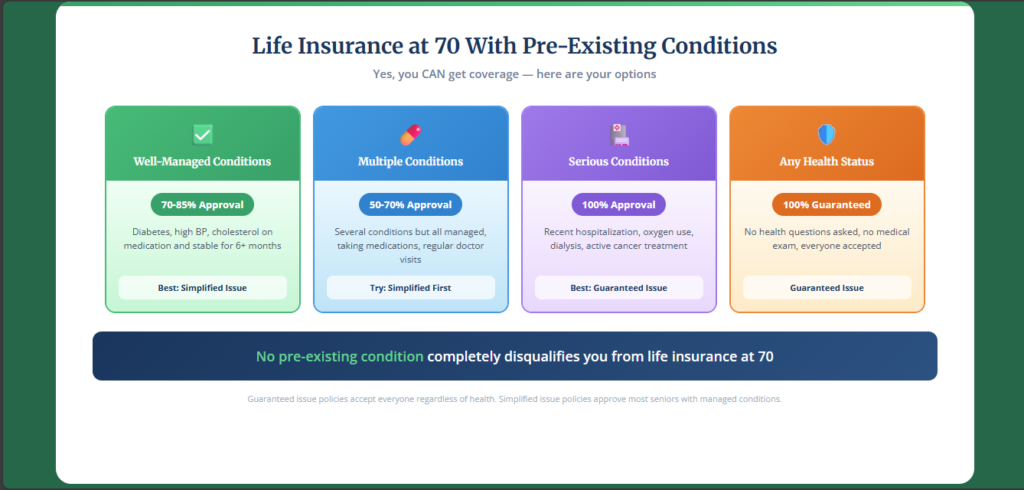
Let’s be clear from the start: pre-existing conditions do not disqualify you from life insurance at age 70. Here’s why:
Guaranteed Issue Life Insurance
Guaranteed issue policies accept everyone regardless of health conditions—no questions asked, no medical exam required. If you can answer basic questions like your name and address, you qualify. Period.
Simplified Issue Life Insurance
Simplified issue policies ask health questions but no medical exam. Many seniors with well-managed conditions like diabetes, high blood pressure, and even some heart conditions get approved.
The Bottom Line
| Your Situation | Best Option | Approval Odds |
|---|---|---|
| Well-managed chronic conditions | Simplified Issue | 70-85% |
| Multiple serious conditions | Guaranteed Issue | 100% |
| Recent hospitalization | Guaranteed Issue | 100% |
| Healthy for your age | Simplified Issue | 90%+ |
Which Pre-Existing Conditions Qualify for Coverage?
Almost every health condition can get coverage—the question is which type of policy and at what rate. Here’s a comprehensive breakdown of life insurance for seniors with health issues.
Conditions That Often Qualify for Simplified Issue (No Exam)
These conditions, when well-managed, typically qualify for simplified issue policies with no medical exam:
Cardiovascular Conditions:
- High blood pressure (controlled with medication, under 160/100)
- High cholesterol (on statins, stable levels)
- Atrial fibrillation (controlled, no recent episodes)
- Heart attack (if 2+ years ago with good recovery)
- Stent placement (if 1+ year ago, no complications)
- Bypass surgery (if 3+ years ago with good recovery)
- Stroke/TIA
Metabolic Conditions:
- Type 2 diabetes (A1C under 8.5-9.0, well-managed)
- Pre-diabetes
- Thyroid conditions (on medication, stable)
Respiratory Conditions:
- Mild-moderate COPD (no oxygen use)
- Asthma (controlled with inhalers)
- Sleep apnea (using CPAP)
Other Common Conditions:
- Arthritis
- Osteoporosis
- Depression/anxiety (stable, on medication)
- Kidney disease (early stages, not on dialysis)
- Cancer history (5+ years cancer-free for most types)
Conditions That Typically Require Guaranteed Issue
These conditions usually need guaranteed issue policies, which accept everyone:
- Current oxygen use for any reason
- Dialysis or end-stage kidney disease
- Active cancer or recent cancer treatment (within 2-5 years)
- Recent heart attack or stroke (within 1-2 years)
- Congestive heart failure (CHF)
- ALS, Parkinson’s, or Alzheimer’s disease
- Cirrhosis or liver failure
- AIDS/HIV (though some simplified issue companies now accept)
- Multiple recent hospitalizations
- Terminal illness diagnosis
The “Gray Area” Conditions
These conditions may qualify for either simplified or guaranteed issue depending on severity and management:
- Diabetes with complications (may need guaranteed)
- COPD with oxygen (guaranteed issue)
- Heart disease with recent events (guaranteed if within 2 years)
- Cancer within 2-5 years (depends on type and stage)
- Multiple conditions combined (depends on stability)
Key Insight: Underwriters care more about how well you manage your conditions than the diagnosis itself. If you take medications as prescribed, see doctors regularly, and have stable numbers, you have much better approval odds.
Types of Life Insurance Available at 70
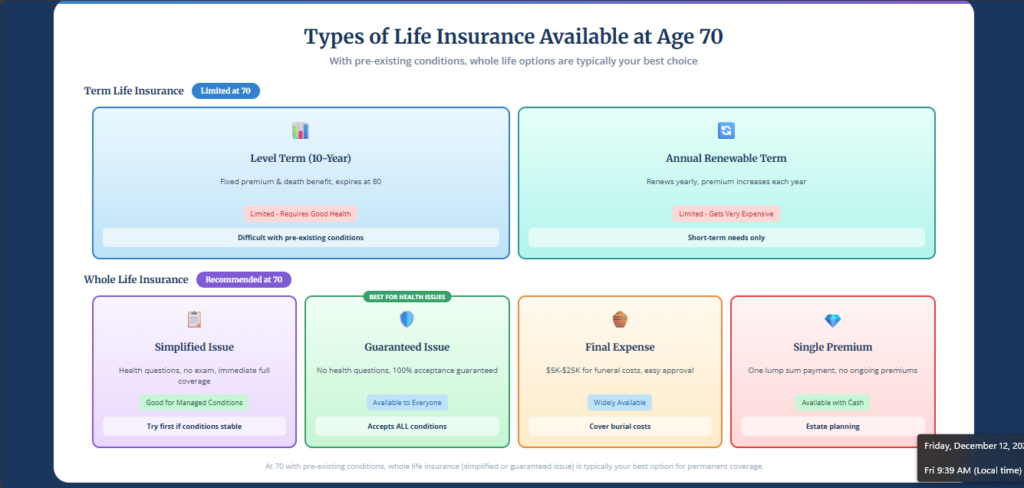
At age 70, you have access to both term life and permanent life insurance options, though your choices become more limited compared to younger ages.
Term Life Insurance at 70
Term life provides coverage for a specific period. At 70, your options are typically limited to 10-year terms.
1. Level Term Life Insurance
What it is: Fixed premium and death benefit for 10 years.
Availability at 70: Limited. Many companies cap term insurance at age 70-75. Coverage amounts may also be limited to $100,000-$250,000.
Best for: Seniors in good health who need coverage for a specific period (paying off a mortgage, providing for a spouse until they reach a certain age).
Pros:
- Lowest cost if you can qualify
- Fixed premiums for 10 years
- Higher coverage amounts than whole life
Cons:
- Difficult to qualify with health conditions
- Expires at age 80
- No coverage after term ends
- Limited availability at 70
2. Annual Renewable Term (ART)
What it is: One-year term that renews annually without re-qualifying medically.
Availability at 70: More widely available than level term.
Best for: Seniors who need temporary coverage and can afford increasing premiums.
Pros:
- Easier to qualify initially
- No medical re-qualification to renew
- Flexibility to cancel anytime
Cons:
- Premiums increase every year
- Becomes very expensive by age 75-80
- Not cost-effective long-term
Whole Life Insurance at 70
Whole life provides permanent coverage that never expires—ideal for seniors who want guaranteed protection.
1. Simplified Issue Whole Life
What it is: Permanent coverage with health questions but no medical exam.
Availability at 70: Widely available up to age 80-85.
Best for: Seniors with manageable health conditions who want permanent coverage without the hassle of medical exams.
How it works:
- Answer 10-20 health questions
- No blood tests, no doctor visits
- Approval decision within days
- Immediate full coverage if approved
Pros:
- No medical exam required
- Permanent coverage
- Full death benefit from day one
- Builds cash value
Cons:
- Must answer health questions honestly
- Some conditions may cause denial
- Higher premiums than fully underwritten policies
2. Guaranteed Issue Whole Life
What it is: Permanent coverage with NO health questions and NO medical exam. Everyone who applies is accepted.
Availability at 70: Widely available up to age 80-85.
Best for: Seniors with serious health conditions who cannot qualify for simplified issue.
How it works:
- No health questions asked
- No medical exam
- 100% acceptance guaranteed
- 2-3 year graded benefit period (natural death)
- Accidental death covered immediately
- Year 1: If you die from natural causes, beneficiaries receive premiums paid + interest (typically 10%)
- Year 2: If you die from natural causes, beneficiaries receive 30-50% of death benefit (varies by company)
- Year 3+: Full death benefit for any cause of death
- Accidental death: Full benefit from day one
Pros:
- 100% guaranteed acceptance
- No health questions
- No medical exam
- Coverage available up to age 85
Cons:
- 2-3 year waiting period for natural death
- Higher premiums than simplified issue
- Limited coverage amounts ($5,000-$25,000)
3. Final Expense / Burial Insurance
What is Final Expense Insurance? Small whole life policies ($5,000-$25,000) designed specifically for funeral costs.
Availability at 70: Very widely available, both simplified and guaranteed issue options.
Best for: Covering funeral expenses and relieving family burden.
Pros:
- Affordable monthly payments
- Easy to qualify
- Permanent coverage
- Available to age 85+
Cons:
- Limited coverage amounts
- Higher cost per $1,000 of coverage
4. Single Premium Whole Life
What it is: One lump sum payment for lifetime coverage, no ongoing premiums.
Availability at 70: Available with medical underwriting or guaranteed issue options.
Best for: Seniors with savings who want to leverage money into a larger death benefit.
Pros:
- No ongoing premium payments
- Immediate coverage
- Leverages cash into larger death benefit
Cons:
- Requires significant upfront payment
- May have tax implications (MEC)
Guaranteed Issue vs. Simplified Issue: Which Should You Choose?
This is the most important decision for seniors with pre-existing conditions is should I choose Guaranteed Issue vs Simplified Issue. Here’s how to decide:
Try Simplified Issue First If:
✓ Your conditions are well-managed with medication ✓ You haven’t been hospitalized in the past 1-2 years ✓ Your chronic conditions have been stable for 6+ months ✓ You’re not currently using oxygen ✓ You’re not on dialysis ✓ You haven’t had a heart attack or stroke in the past 2 years ✓ You’re not currently being treated for cancer
Why try simplified first? You’ll get:
- Lower premiums (20-40% less than guaranteed issue)
- Immediate full death benefit (no waiting period)
- Potentially higher coverage amounts
Go Directly to Guaranteed Issue If:
✓ You currently use oxygen ✓ You’re on dialysis ✓ You’ve had a heart attack or stroke within the past 2 years ✓ You’re currently being treated for cancer ✓ You have multiple serious conditions ✓ You’ve been declined for simplified issue before ✓ You have ALS, Parkinson’s, Alzheimer’s, or dementia
Why go straight to guaranteed? You’ll:
- Avoid wasting time on applications that will be declined
- Get coverage immediately (though with waiting period)
- Have 100% certainty of acceptance
The Smart Strategy: Apply for Both
Many insurance agents recommend this approach:
- Apply for simplified issue first at a lenient company like Mutual of Omaha or AIG
- Simultaneously apply for guaranteed issue as a backup
- If simplified is approved, cancel the guaranteed issue application
- If simplified is declined, you already have guaranteed issue in place
This ensures you never go without coverage while giving yourself the best chance at lower rates.
Life Insurance Rates at 70 With Pre-Existing Conditions
Understanding what you’ll pay helps you budget and choose the right coverage. Rates vary significantly based on health status.
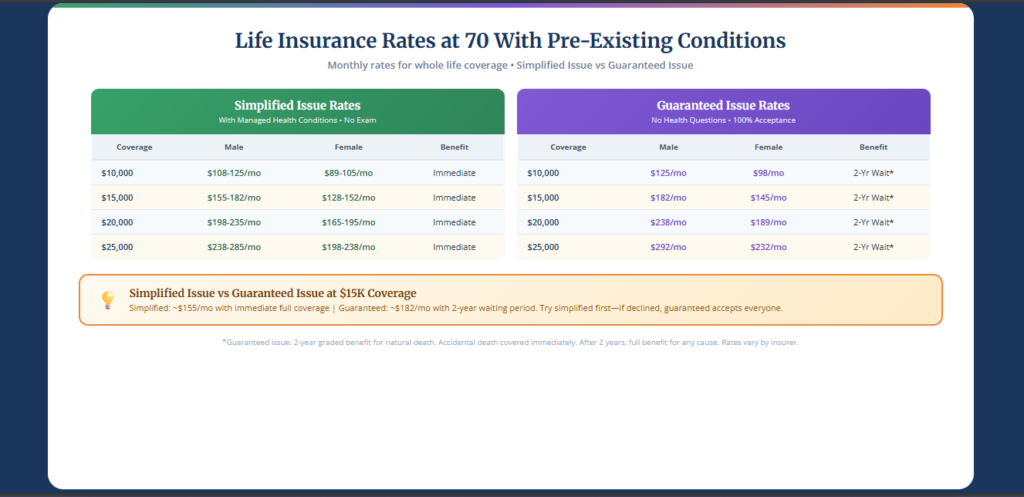
Simplified Issue Rates at Age 70 (Health Conditions)
These rates are for seniors with managed conditions like diabetes, high blood pressure, or heart disease history.
Simplified Issue Whole Life – Male Age 70
| Coverage | Standard Health | Minor Conditions | Moderate Conditions |
|---|---|---|---|
| $10,000 | $89/mo | $108/mo | $125/mo |
| $15,000 | $128/mo | $155/mo | $182/mo |
| $20,000 | $165/mo | $198/mo | $235/mo |
| $25,000 | $198/mo | $238/mo | $285/mo |
Simplified Issue Whole Life – Female Age 70
| Coverage | Standard Health | Minor Conditions | Moderate Conditions |
|---|---|---|---|
| $10,000 | $72/mo | $89/mo | $105/mo |
| $15,000 | $105/mo | $128/mo | $152/mo |
| $20,000 | $135/mo | $165/mo | $195/mo |
| $25,000 | $162/mo | $198/mo | $238/mo |
Minor conditions: Well-controlled high blood pressure, high cholesterol on medication Moderate conditions: Type 2 diabetes (A1C under 8.5), stable heart condition 2+ years ago
Guaranteed Issue Rates at Age 70
These rates are for guaranteed acceptance policies—no health questions asked.
Guaranteed Issue Whole Life – Age 70
| Coverage | Male Monthly | Female Monthly | Annual Cost |
|---|---|---|---|
| $5,000 | $65/mo | $52/mo | $624-$780 |
| $10,000 | $125/mo | $98/mo | $1,176-$1,500 |
| $15,000 | $182/mo | $145/mo | $1,740-$2,184 |
| $20,000 | $238/mo | $189/mo | $2,268-$2,856 |
| $25,000 | $292/mo | $232/mo | $2,784-$3,504 |
Term Life Rates at Age 70 (If You Qualify)
Term life is harder to get at 70 with health conditions, but here are rates for those who qualify.
10-Year Term Life – Age 70 (Preferred Health)
| Coverage | Male Monthly | Female Monthly |
|---|---|---|
| $50,000 | $145/mo | $108/mo |
| $100,000 | $275/mo | $198/mo |
| $150,000 | $398/mo | $285/mo |
| $200,000 | $515/mo | $368/mo |
| $250,000 | $628/mo | $448/mo |
Note: Term life at 70 typically requires good health. Those with significant pre-existing conditions are usually declined for term coverage.
Real-World Examples: Getting Approved at 70 With Health Issues
Let’s look at how real seniors with pre-existing conditions got life insurance coverage.
Example 1: William – Diabetes + High Blood Pressure
Situation: William, 70, has Type 2 diabetes (A1C 7.8) and high blood pressure controlled with Lisinopril. He takes Metformin for diabetes. Both conditions have been stable for 5+ years.
Strategy: Applied for simplified issue through Mutual of Omaha.
Result: Approved for $20,000 whole life coverage at $178/month.
Why he was approved: Both conditions were well-managed, he sees his doctor every 3 months, takes medications consistently, and hasn’t been hospitalized in over 8 years.
Savings vs. guaranteed issue: $57/month ($684/year)
Example 2: Dorothy – COPD With Oxygen Use
Situation: Dorothy, 71, has severe COPD and uses supplemental oxygen. She knew simplified issue would decline her.
Strategy: Applied directly for guaranteed issue through Globe Life.
Result: Approved for $15,000 coverage at $178/month with a 2-year graded benefit period.
Why this worked: Guaranteed issue accepts everyone—no health questions asked. After 2 years, her full $15,000 death benefit is in effect. Accidental death was covered from day one.
Key insight: Dorothy didn’t waste time applying for simplified issue policies that would decline her. She got coverage immediately.
Example 3: Robert – Heart Attack 3 Years Ago
Situation: Robert, 70, had a heart attack 3 years ago, received two stents, and has made an excellent recovery. He takes blood thinners and cholesterol medication.
Strategy: Applied for simplified issue through AIG, which is known for being lenient with heart conditions after 2+ years.
Result: Approved for $25,000 whole life coverage at $268/month (rated up due to heart history).
Why he was approved: His heart attack was 3+ years ago, he had no complications, excellent recovery, and consistently takes all medications. AIG considers the “whole picture.”
Alternative if declined: If AIG had declined, Robert had a guaranteed issue backup application ready.
Example 4: Margaret – Cancer Survivor
Situation: Margaret, 72, had breast cancer 6 years ago. She completed treatment and has been cancer-free for 5+ years with regular check-ups.
Strategy: Applied for simplified issue through Mutual of Omaha, which often approves cancer survivors after 5 years.
Result: Approved for $20,000 whole life coverage at $165/month at standard rates.
Why she was approved: She was 5+ years cancer-free with no recurrence, and breast cancer (caught early, successfully treated) is viewed more favorably than some other cancers.
Example 5: James – Multiple Conditions + Recent Hospitalization
Situation: James, 70, has diabetes, heart disease, COPD, and was hospitalized 6 months ago for pneumonia. He knew his health profile was complex.
Strategy: Applied directly for guaranteed issue—didn’t waste time on simplified issue that would certainly decline him.
Result: Approved for $20,000 guaranteed issue coverage at $238/month with 2-year graded benefit.
Why this was the right choice: With multiple serious conditions and recent hospitalization, simplified issue would have declined him. Guaranteed issue gave him certain approval and peace of mind. After 2 years, his family will receive the full $20,000 death benefit.
How to Get the Best Rates With Pre-Existing Conditions
Follow these strategies to maximize your approval odds and minimize your premiums:
1. Be Completely Honest on Applications
Insurance companies verify your medical history through the MIB (Medical Information Bureau) and prescription database checks. If you lie or omit conditions:
- Your application may be denied
- Your claim may be denied after death (your family gets nothing)
- You may be flagged in the MIB, making future applications harder
Always disclose everything. Companies expect seniors to have health conditions—they’re not looking for perfect health.
2. Show You’re Managing Your Conditions
Underwriters want to see:
- Regular doctor visits (every 3-6 months for chronic conditions)
- Consistent medication compliance
- Stable or improving numbers (A1C, blood pressure, cholesterol)
- No recent hospitalizations or ER visits
- Following treatment plans
3. Apply to the Right Companies
Not all insurance companies view health conditions the same way. Some are more lenient:
Most Lenient for Health Conditions:
- Mutual of Omaha
- AIG
- Transamerica
- Foresters Financial
- Gerber Life
Best Guaranteed Issue Options:
- Globe Life
- Colonial Penn
- AARP/New York Life
- Mutual of Omaha (guaranteed product)
- AIG (guaranteed product)
4. Work With an Independent Agent
Independent agents can:
- Shop multiple companies for you
- Know which companies are lenient for specific conditions
- Submit applications strategically
- Help you avoid wasting time on companies that will decline you
5. Consider a Hybrid Approach
Many seniors benefit from combining policies:
Example Strategy:
- $15,000 simplified issue whole life (if you qualify) – for immediate full coverage
- $10,000 guaranteed issue whole life (backup) – ensures coverage regardless of health
- Total: $25,000 coverage with part immediate and part after waiting period
6. Don’t Wait—Rates Only Increase
Every year you delay:
- Premiums increase 8-12% per year of age
- Your health may decline, limiting options further
- Conditions that qualify for simplified issue today may require guaranteed issue later
Apply now while you have the most options.

Common Mistakes to Avoid
Mistake #1: Assuming You Can’t Get Coverage
Many seniors with serious health conditions assume they can’t qualify for any life insurance. This is false—guaranteed issue accepts everyone. Don’t self-reject.
Mistake #2: Lying on Applications
Some seniors omit conditions hoping to get better rates. This backfires when:
- The prescription database check reveals your medications
- Your claim is denied after death, leaving family with nothing
- You’re flagged in the MIB system
Honesty is always the best policy.
Mistake #3: Only Applying to One Company
Different companies have vastly different underwriting guidelines. A condition that gets you declined at Company A might get approved at Company B.
Mistake #4: Choosing the Cheapest Policy Without Understanding Terms
Guaranteed issue policies have waiting periods. Make sure you understand:
- What happens if you die in year 1 or 2
- When the full death benefit kicks in
- What’s covered immediately (accidental death)
Mistake #5: Waiting for Health to Improve
Your health at 70 is unlikely to significantly improve. Every year you wait:
- Premiums increase substantially
- New conditions may develop
- Current conditions may worsen
- Your options become more limited
Mistake #6: Not Having Enough Coverage
Final expenses average $15,000-$25,000. A $5,000 policy may not be enough. Consider:
- Funeral costs: $7,000-$15,000
- Burial/cremation: $1,000-$5,000
- Outstanding medical bills
- Any debts you want to clear
Frequently Asked Questions
Can you get life insurance at 70 with pre-existing conditions?
Yes, absolutely. Millions of 70-year-olds with pre-existing conditions get life insurance every year. If your conditions are well-managed, you may qualify for simplified issue policies with no medical exam.
If you have serious or multiple conditions, guaranteed issue policies accept everyone regardless of health—no questions asked. The key is choosing the right type of policy for your health situation.
What pre-existing conditions disqualify you from life insurance at 70?
No pre-existing condition completely disqualifies you from life insurance because guaranteed issue policies accept everyone. However, certain conditions typically require guaranteed issue rather than simplified issue, including: current oxygen use, dialysis, active cancer treatment, recent heart attack or stroke (within 1-2 years), ALS, Parkinson’s, Alzheimer’s, or terminal illness diagnosis.
Most other conditions—including diabetes, heart disease history, COPD without oxygen, and cancer survivorship—can often qualify for simplified issue if well-managed.
How much does life insurance cost at 70 with health problems?
For simplified issue policies at age 70 with moderate health conditions, expect to pay approximately $125-$285 per month for $10,000-$25,000 in coverage. Guaranteed issue policies (for those with serious conditions) cost more—approximately $125-$292 per month for similar coverage. Women typically pay 15-25% less than men. Your exact rate depends on the severity of your conditions, coverage amount, and which company you choose.
Is there life insurance with no health questions for seniors?
Yes, guaranteed issue life insurance has absolutely no health questions. You cannot be declined for any reason—if you apply, you’re approved. The trade-off is a 2-3 year graded benefit period where natural death benefits are limited. After the waiting period, full benefits apply. Accidental death is covered at full benefit from day one. Coverage amounts typically range from $5,000-$25,000.
Can I get life insurance at 70 with diabetes?
Yes. Type 2 diabetes is one of the most common conditions among seniors, and many companies specialize in covering diabetics. If your diabetes is well-managed (A1C under 8.5-9.0, no serious complications like kidney disease or amputation, taking medications consistently), you can often qualify for simplified issue policies.
If your diabetes is less controlled or you have complications, guaranteed issue policies will accept you regardless.
Can I get life insurance at 70 after a heart attack?
Yes. If your heart attack was 2+ years ago with good recovery and no recent complications, many simplified issue companies (like AIG and Mutual of Omaha) will approve you at rated premiums.
If your heart attack was recent (within 1-2 years) or you have ongoing complications, guaranteed issue will accept you immediately. Many heart attack survivors get coverage—the key is demonstrating stable recovery.
What is guaranteed issue life insurance?
Guaranteed issue life insurance is a type of whole life policy that accepts all applicants regardless of health conditions—no health questions asked, no medical exam required.
The trade-off is a 2-3 year graded benefit period: if you die from natural causes in the first 2-3 years, beneficiaries receive premiums paid plus interest (or a percentage of the death benefit). After the waiting period, full benefits apply for any cause of death. Accidental death is covered in full from day one.
Is term life insurance available at 70 with pre-existing conditions?
Term life insurance at 70 with pre-existing conditions is very difficult to obtain. Most term policies require full medical underwriting, and many companies don’t offer term insurance past age 70. If you have significant health conditions, term insurance is usually not an option.
Most seniors with pre-existing conditions at 70 choose whole life insurance (either simplified issue or guaranteed issue) because it’s more accessible and provides permanent coverage.
How long is the waiting period for guaranteed issue life insurance?
The waiting period for guaranteed issue life insurance is typically 2-3 years depending on the company. During this period, if you die from natural causes, your beneficiaries receive your premiums paid plus interest (usually 10%) or a percentage of the death benefit.
After the waiting period ends, the full death benefit applies to any cause of death. Important: accidental death is covered at the full death benefit amount from day one—there’s no waiting period for accidents.
Should I get simplified issue or guaranteed issue at 70?
Start with simplified issue if your conditions are well-managed, you haven’t been hospitalized recently, and you’re not using oxygen or on dialysis. Simplified issue offers lower premiums and immediate full coverage.
If you have serious conditions, recent hospitalizations, or have been declined before, go directly to guaranteed issue—it accepts everyone and guarantees you coverage. Many advisors recommend applying for both simultaneously: if simplified approves you, cancel the guaranteed issue application; if simplified declines you, you already have guaranteed issue in place.
Taking the Next Step
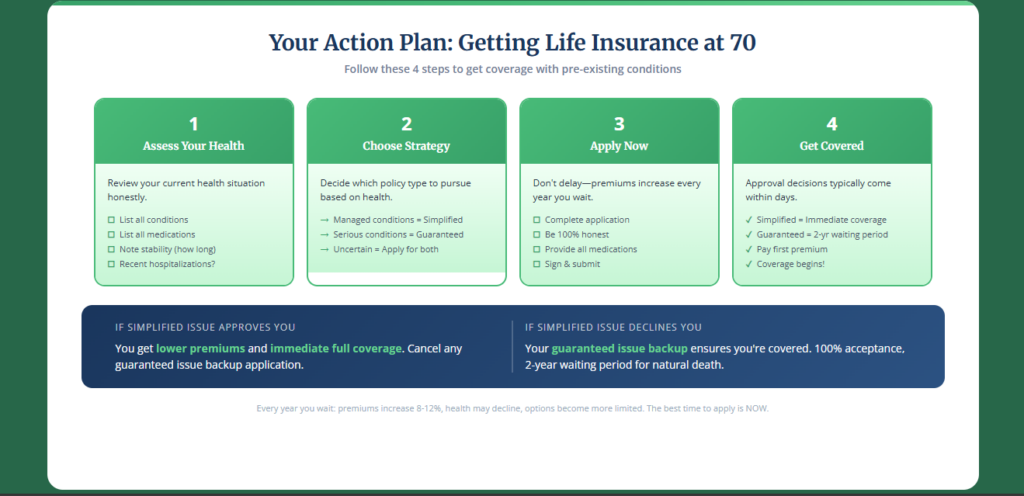
Getting life insurance at 70 with pre-existing conditions is absolutely possible. Here’s your action plan:
Step 1: Assess Your Health Situation
- List all your conditions and medications
- Note how long each condition has been stable
- Consider any recent hospitalizations
Step 2: Choose Your Strategy
- Well-managed conditions → Try simplified issue first
- Serious/multiple conditions → Go directly to guaranteed issue
- Uncertain → Apply for both simultaneously
Step 3: Apply Now
- Every year you wait, premiums increase 8-12%
- Your health may change, limiting future options
- There’s no benefit to waiting
Step 4: Work With a Professional
- An independent agent can shop multiple companies
- They know which companies are lenient for your specific conditions
- They can help you avoid wasting time on applications that will be declined
Remember: Pre-existing conditions don’t disqualify you from life insurance—they just change which type of policy is best for your situation. Millions of seniors with health issues have coverage. You can too.
Disclaimer
This article is for informational purposes only and does not constitute financial, legal, medical, or insurance advice. Life insurance rates and availability vary based on individual factors including age, health conditions, medications, and the specific insurance company. The rates shown are estimates and may not reflect your actual costs. Pre-existing conditions affect underwriting decisions differently at each company. Always consult with a licensed insurance professional for personalized recommendations and a healthcare provider for medical advice. Guaranteed issue policies have graded benefit periods—review policy terms carefully before purchasing.