Life Insurance after Open Heart Surgery for Seniors-2026 Guide
 Posted in Final Expense Life Insurance on July 9, 2026 last updated on July 15, 2026
Can seniors get life insurance after open heart surgery?
| Yes. Most seniors can qualify for life insurance after open heart surgery. If your recovery has been stable for at least 6 to 12 months, many insurance companies will consider you for fully underwritten coverage. Even if your surgery was more recent—or you want to avoid a medical exam—you may still qualify for simplified issue or guaranteed issue life insurance. |
In most cases:
- Most fully underwritten policies become available 6–12 months after surgery
- Standard to Table-rated approvals are common after a good recovery
- No-medical-exam policies are available for many seniors
- Bypass surgery does not automatically mean you’ll be declined
- Shopping multiple insurance companies can significantly improve your chances of receiving a better rate
If you’ve been through open heart surgery, you’ve already faced one of the biggest health challenges of your life — and come out the other side. Now you’re wondering whether life insurance is still on the table. I have good news: it absolutely is.
Life insurance companies see thousands of applications every year from seniors who’ve had bypass surgery, valve repair, or other open heart procedures. They have well-established guidelines for these cases, and the majority of applicants get approved. As a licensed independent agent appointed with more than a dozen carriers, I help seniors with cardiac histories find coverage every week. In this guide, I’ll show you exactly how underwriting works after open heart surgery, when to apply, which policies fit best, which companies to consider, and what you can realistically expect to pay.
What Is Open Heart Surgery?
According to the CDC, open heart surgery is any procedure where the chest is surgically opened to operate on the heart muscle, valves, or arteries. For seniors, the most common types are:
- Coronary artery bypass grafting (CABG) — often called bypass surgery. Surgeons graft healthy vessels around blocked coronary arteries to restore blood flow. Bypasses can be single, double, triple, or quadruple depending on how many arteries are involved.
- Heart valve repair or replacement — fixing or replacing a valve that’s narrowed or leaking, using a mechanical or biological valve.
- Aneurysm repair — repairing a weakened or bulging section of the aorta or heart wall.
- Combination procedures — for example, a bypass and valve replacement performed in the same operation.
To a life insurance underwriter, the type of procedure matters — but what matters even more is why you needed it, how you recovered, and how healthy your heart is today.
Can You Get Life Insurance After Open Heart Surgery?
Yes. Open heart surgery is considered a major cardiovascular event, so you shouldn’t expect Preferred Plus rates — but an approval is very realistic. Most carriers want to see at least 6 to 12 months of documented stability after surgery before offering a fully underwritten policy, and many applicants with strong recoveries land in the Standard to Table 4 range. The longer you’re out from surgery with clean checkups, the better your rate class tends to get.
| Key takeaway Time since surgery is one of the most powerful factors in your rate. Within the first year, expect postponements or higher table ratings on fully underwritten policies. At two or more years out with good cardiac test results, rates improve significantly — and simplified issue final expense coverage is often available with no exam at all. |
Elective Surgery vs. Emergency Surgery: Why It Matters
Elective / Preventive Procedures
If your surgery was planned — for example, a blockage was caught during a routine stress test and you had bypass surgery before any heart attack occurred — underwriters view your case more favorably. An elective procedure suggests the problem was caught early and treated proactively, and applicants in this category with strong recoveries often see Standard to Table 2 offers once they’re a couple of years out.
Emergency Procedures / Surgery After a Heart Attack
If your open heart surgery followed a heart attack or was performed on an emergency basis, underwriters will factor in the heart muscle damage that occurred, your ejection fraction, and any complications during or after surgery. These cases typically land one to several table ratings lower than elective cases — but they are still very insurable, especially with consistent cardiology follow-up.
| Surgical Scenario | Underwriting View | Typical Best-Case Rating |
| Elective single bypass, 2+ years ago, strong recovery | Favorable for a cardiac case | Standard to Table 2 |
| Elective multi-vessel bypass, stable, good tests | Moderate concern | Table 2–4 |
| Bypass after heart attack, full recovery, normal EF | Higher concern, case-by-case | Table 2–6 |
| Surgery within the last 12 months | Postpone or high rating likely | Table 6+ or simplified/GI |
| Complications, low ejection fraction, or ongoing symptoms | Significant concern | Guaranteed issue |
These are general guidelines, and the same case can be rated two to four tables apart by different carriers — which is exactly why shopping your case across multiple companies matters so much after heart surgery.
Underwriting Factors Insurers Consider
When you apply for life insurance after open heart surgery, underwriters will typically review:
- Time since surgery — the single biggest driver of your rating
- Type of procedure and number of vessels bypassed or valves involved
- Whether the surgery was elective or followed a heart attack
- Your ejection fraction and most recent echocardiogram or stress test results
- Completion of cardiac rehabilitation — a strong positive signal to underwriters
- Medication compliance (statins, beta-blockers, blood thinners, ACE inhibitors)
- Current blood pressure, cholesterol, and blood sugar control
- Lifestyle changes since surgery: tobacco cessation, weight management, exercise
- Any complications during or after surgery, and any ongoing symptoms
Recovery Timeline: When Should You Apply for Life Insurance?
One of the biggest questions seniors ask is whether they should apply now or wait. The answer depends on your recovery, but waiting isn’t always the best strategy.
| Time Since Surgery | What to Expect |
|---|---|
| 0–6 Months | Most fully underwritten companies postpone applications. Guaranteed issue policies are usually available immediately. |
| 6–12 Months | Many companies begin considering applications if recovery is stable and your cardiologist reports good progress. |
| 1–2 Years | More carriers become available and underwriting becomes more favorable. |
| 2–5 Years | Many applicants receive Standard or mild Table ratings with good cardiac history. |
| 5+ Years | Strong long-term stability often produces the most competitive offers available for applicants with previous heart surgery. |
Pro Tip: Every birthday increases the cost of life insurance. Sometimes buying coverage now and improving it later can cost less than waiting another two years to apply.
| Underwriter tip Before applying, gather your surgical records, most recent stress test or echocardiogram, cardiac rehab completion documentation, and a current medication list. A recent clean stress test can be the difference between a postponement and an approval — if yours is more than two years old, consider scheduling one with your cardiologist before you apply. |

How Different Types of Open Heart Surgery Affect Life Insurance
Not all open heart surgeries are viewed the same by insurance companies. Underwriters look closely at why the surgery was needed, how extensive it was, and how well you’ve recovered.
| Surgery | Underwriter Perspective |
|---|---|
| Single Bypass (CABG) | Often viewed most favorably among bypass procedures |
| Double Bypass | Moderate concern depending on overall health |
| Triple Bypass | Higher risk due to more extensive coronary artery disease |
| Quadruple Bypass | Greater scrutiny but still commonly insurable |
| Valve Repair | Often favorable if valve function is fully restored |
| Valve Replacement | Depends on valve type and follow-up testing |
| TAVR | Becoming increasingly accepted by many insurers |
| Bypass + Valve Surgery | More complex underwriting but still insurable for many seniors |
| Aortic Aneurysm Repair | Highly individualized underwriting review |
Remember, the surgery itself isn’t the only factor. Insurance companies often place even greater weight on your recovery, current heart function, and recent cardiac testing.
Comparing Your Life Insurance Options After Open Heart Surgery
Choosing the right policy depends on your health, your budget, how recently your surgery occurred, and your willingness to complete an exam.
| Policy Type | Medical Exam | Coverage Amount | Approval Speed | Best For |
|---|---|---|---|---|
| Guaranteed Issue Whole Life | No | $5,000–$25,000 | Days | Recent surgery or serious complications |
| Simplified Issue Final Expense | No | $10,000–$50,000 | Days | Stable seniors wanting fast approval |
| Term Life Insurance | Usually | Up to several million dollars | Several weeks | Income replacement and mortgage protection |
| Whole Life Insurance | Sometimes | Varies | Several weeks | Permanent lifetime coverage |
| Guaranteed Universal Life | Usually | High coverage amounts | Several weeks | Affordable permanent protection |
One tip worth knowing: if you receive a table rating, the structure of the product affects how much that rating costs you. A Table 4 rating on a guaranteed universal life policy is often meaningfully cheaper per month than the same Table 4 on traditional whole life, simply because of how the products are priced. If permanent coverage is the goal, it pays to quote both.
Best Life Insurance Companies After Open Heart Surgery
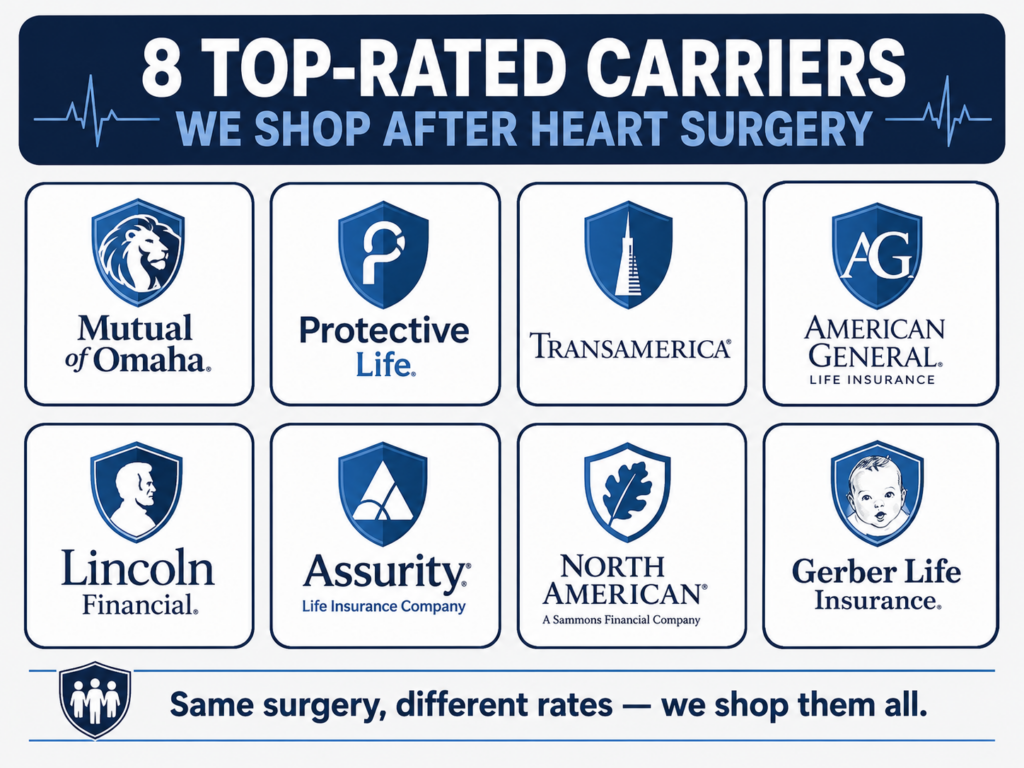
Life Insurance companies underwrite cardiac surgery cases very differently — the same triple bypass can come back Table 2 from one company and Table 6 from another. As an independent agent appointed with the following carriers, here’s how I’d position them for open heart surgery applicants:
| Company | Product Types | Max Coverage | Best For |
| Mutual of Omaha | Simplified Issue / Term / Whole Life | $2M | Stable recoveries seeking no-exam final expense |
| Protective Life | Term / Universal Life | $10M+ | Competitive GUL pricing for table-rated cases |
| Transamerica | Term / IUL | $10M+ | Flexible cardiac underwriting on term |
| American General (AIG) | Term / Whole Life | $10M+ | Often strongest on post-bypass cases |
| Lincoln National | Term / Universal Life | $10M+ | Larger face amounts 2+ years post-surgery |
| Assurity | Simplified Issue / Term | $1M | Fast no-exam approvals for stable cases |
| North American | IUL / Whole Life | $5M+ | Permanent coverage with living benefits riders |
| Gerber Life | Guaranteed Issue / Whole Life | $25,000 | Recent surgery or prior declines |
Rankings reflect general underwriting flexibility for cardiac surgery cases and are not a guarantee of approval or rate class. Your results depend on your full health profile and time since surgery.
Life Insurance after Open Heart Surgery Sample Monthly Rates
The rates below are illustrative examples assuming surgery two or more years ago with a stable, well-documented recovery. Actual rates vary by carrier, state, gender, table rating, and overall health.
| Age | Gender | Policy | Estimated Monthly Rate |
| 65 | Male | $25,000 Final Expense (Simplified Issue) | $85–$110/mo |
| 65 | Female | $25,000 Final Expense (Simplified Issue) | $68–$92/mo |
| 70 | Male | $25,000 Final Expense (Simplified Issue) | $110–$145/mo |
| 70 | Female | $25,000 Final Expense (Simplified Issue) | $90–$120/mo |
| 65 | Male | $250,000 10-Year Term (Table 2–4) | $190–$310/mo |
| 65 | Female | $250,000 10-Year Term (Table 2–4) | $150–$250/mo |
| 70 | Male | $25,000 Guaranteed Issue Whole Life | $130–$165/mo |
If you’re less than two years out from surgery, expect higher table ratings on fully underwritten policies — or lean on simplified issue and guaranteed issue options until your rate class improves. Many of my clients lock in coverage now and then reapply for a better rate class once they hit the two-year or five-year mark with clean test results.
What Can Help You Get a Better Life Insurance Rate?

While you can’t change your surgical history, there are several things that can improve your underwriting results.
Insurance companies like to see:
- A normal stress test
- Stable echocardiogram results
- Good ejection fraction
- Completion of cardiac rehabilitation
- Controlled blood pressure
- Controlled cholesterol
- Well-managed diabetes, if applicable
- No tobacco use
- Healthy weight
- Regular exercise approved by your physician
- Consistent medication compliance
- No additional cardiac procedures since surgery
- Regular follow-up visits with your cardiologist
Each positive factor helps demonstrate that your heart condition is stable and well managed.
Common Reasons Seniors Get Declined After Open Heart Surgery
A decline doesn’t always mean you’re uninsurable.
Insurance companies may postpone or decline an application because:
- Your surgery was too recent.
- You’re waiting for another cardiac procedure.
- Your cardiologist hasn’t released updated stress test results.
- Your ejection fraction remains significantly reduced.
- You’ve recently been hospitalized.
- Your medications are still being adjusted.
- Other serious medical conditions increase your overall risk.
Many of these situations improve with time. Once your recovery stabilizes, your options often expand significantly. In the meantime, guaranteed issue or simplified issue coverage can provide valuable protection until you’re eligible for more competitive policies.
How Much Does Your Recovery Affect Your Life Insurance Rate?
The quality of your recovery often has a bigger impact on your life insurance premium than the surgery itself.
Insurance companies understand that open heart surgery is designed to improve your long-term health. What they’re really evaluating is how your heart has performed since the procedure. Someone who had bypass surgery five years ago with excellent follow-up care may receive a much better offer than someone who had surgery only eight months ago—even if they had the exact same procedure.
Here’s what that can look like in real life:
| Recovery Scenario | Likely Underwriting Outcome |
|---|---|
| Surgery 6–12 months ago with stable recovery | Higher table rating or limited carrier options |
| Surgery 2–5 years ago, completed cardiac rehab, normal stress test | Standard to Table 2–4 with many companies |
| Surgery more than 5 years ago with no complications and excellent follow-up | Often the most competitive offers available for applicants with a history of open heart surgery |
| Ongoing chest pain, reduced heart function, or additional cardiac procedures | Higher table ratings, postponement, or guaranteed issue options may be more appropriate |
A few of the biggest factors underwriters look for include:
- A recent stress test with favorable results
- A stable ejection fraction
- No recurring chest pain or angina
- No recent hospitalizations for heart-related conditions
- Completion of cardiac rehabilitation
- Well-controlled blood pressure and cholesterol
- Consistent follow-up with your cardiologist
- Taking prescribed medications as directed
The longer your heart remains stable after surgery, the more confidence an insurance company has that your risk of future complications has decreased. That’s why many applicants see noticeably better offers once they reach the two-year or five-year mark after surgery.
Real-World Example
Imagine two 68-year-old men who both had triple bypass surgery.
Applicant A had surgery eight months ago. His recovery is going well, but he hasn’t completed a follow-up stress test yet. Most fully underwritten insurance companies will either postpone his application or assign a higher table rating until more time has passed.
Applicant B had the same surgery five years ago. He completed cardiac rehabilitation, exercises several times a week, has excellent annual checkups, and his stress tests have remained normal. Even though both men had identical surgeries, Applicant B will usually qualify with more insurance companies and may pay significantly less for the same amount of coverage.
The bottom line: Don’t assume your surgery automatically determines your premium. Insurance companies care just as much—if not more—about how well you’ve recovered. A healthy lifestyle, regular cardiology care, and documented stability can make a meaningful difference in both your approval chances and your monthly premium.
Related Heart Conditions That Can Affect Life Insurance Approval
Open heart surgery is often only one part of your overall heart health history. Insurance companies don’t evaluate your surgery in isolation—they also consider the medical conditions that led to the procedure and any ongoing cardiovascular issues you may have.
If any of the following apply to you, we’ve created detailed guides that explain how each condition can affect your life insurance options and what you can do to improve your chances of approval.
Heart Attack (Myocardial Infarction)
Many open heart surgeries are performed after a heart attack. If your bypass surgery followed a heart attack, insurers will also evaluate the amount of heart muscle damage, your ejection fraction, and how well you’ve recovered. Learn more in our guide to life insurance after a heart attack.
Heart Valve Replacement or Repair
Whether you received a mechanical valve, tissue valve, or underwent a valve repair, insurers will review your follow-up testing, current valve function, and any medications such as blood thinners. Read our guide to life insurance after heart valve replacement for more information.
Coronary Artery Disease (CAD)
Coronary artery disease is the leading reason seniors need bypass surgery. Even after a successful procedure, insurance companies want to know whether your condition has remained stable and whether additional blockages have developed. Our article on life insurance for seniors with heart disease explains what underwriters look for.
High Blood Pressure
Uncontrolled hypertension increases the risk of future heart problems and is closely tied to coronary artery disease. Fortunately, well-managed blood pressure is viewed much more favorably during underwriting. Learn more about life insurance for seniors with high blood pressure.
Atrial Fibrillation (AFib)
Many seniors develop atrial fibrillation before or after open heart surgery. Underwriters consider how well your heart rhythm is controlled, whether you’ve required procedures such as cardioversion or ablation, and if you’re taking anticoagulant medication. Read our complete guide to life insurance for seniors with AFib.
Blood Thinners
If you’re taking medications such as Warfarin, Eliquis, Xarelto, or Pradaxa following your surgery, don’t assume you’ll be declined. Insurance companies evaluate why you’re taking the medication rather than the prescription alone. Learn more in our guide to life insurance for seniors on blood thinners.
Pacemakers and Other Cardiac Devices
Some seniors receive a pacemaker after surgery to help regulate heart rhythm. Modern pacemakers are common, and many applicants still qualify for excellent coverage depending on their overall cardiac health. Read our guide to life insurance for seniors with a pacemaker.
Stroke History
Heart disease and stroke often share many of the same underlying risk factors. If you’ve experienced both, insurers will evaluate your neurological recovery along with your cardiac history. Learn more in our guide to life insurance for seniors after a stroke.
Multiple Health Conditions
Many seniors have more than one medical condition, such as diabetes, COPD, kidney disease, or sleep apnea in addition to heart disease. While multiple conditions can affect your premium, they don’t automatically prevent you from qualifying for life insurance. Our guide to life insurance for seniors with multiple health conditions explains how insurers evaluate these more complex cases.
Why Your Overall Health Matters More Than One Diagnosis
One of the biggest misconceptions about life insurance is that a single diagnosis determines whether you’ll be approved. In reality, underwriters evaluate your complete health picture—including your recovery after surgery, current heart function, medications, lifestyle, and any other medical conditions you may have.
That’s why two people who both had bypass surgery can receive very different offers. By working with an independent agent who can compare multiple insurance companies, you have a much better chance of finding a carrier that views your entire health profile favorably rather than focusing on one diagnosis alone.
Case Studies
Frank, 68 — Elective Triple Bypass, 5 Years Ago
Frank’s blockages were found during a routine stress test and he had elective triple bypass surgery with no heart attack and no complications. Five years later, he takes a statin and blood pressure medication, exercises regularly, and has annual clean checkups. Result: approved at Table 2 on a $250,000 term policy — and we quoted a GUL alongside it that came in even lower per month for permanent coverage.
Eleanor, 74 — Bypass After a Heart Attack, 3 Years Ago
Eleanor had emergency double bypass surgery following a heart attack. She completed cardiac rehab, her ejection fraction recovered to the normal range, and her cardiologist notes show stable annual visits. Result: fully underwritten term was possible but table-rated heavily, so she chose a simplified issue final expense policy with immediate benefits at a premium she was comfortable with.
Raymond, 81 — Surgery 8 Months Ago
Raymond had valve replacement plus a single bypass less than a year before applying. Fully underwritten carriers would have postponed his application until the 12-month mark. Result: approved for a guaranteed issue whole life policy immediately to get coverage in force, with a plan to re-shop for simplified issue coverage at a better rate once he passes the two-year mark with a clean stress test.
Frequently Asked Questions
Can you get life insurance after open heart surgery?
Yes. Most seniors qualify for coverage after open heart surgery. Fully underwritten policies typically become available 6–12 months post-surgery at Standard to Table-rated premiums, and no-exam simplified issue and guaranteed issue policies are available even sooner.
How long after open heart surgery can you apply for life insurance?
Most fully underwritten carriers want at least 6–12 months of documented stability. Guaranteed issue policies have no waiting requirement to apply, and many simplified issue carriers accept applicants once they’re about two years post-surgery.
Will I be declined because I had bypass surgery?
Rarely, if you apply with the right carrier. A decline usually means the case was submitted to a company with strict cardiac guidelines — not that you’re uninsurable. An independent agent can pre-shop your records with multiple underwriters before you formally apply.
What rate class can I expect after bypass surgery?
Preferred rates are generally off the table after open heart surgery, but Standard to Table 4 is realistic for stable recoveries two or more years out. Elective procedures with no heart attack tend to rate better than emergency surgeries.
Does the number of bypasses matter?
Yes. A single bypass generally rates better than a triple or quadruple bypass, since more grafts usually indicate more extensive coronary artery disease. That said, strong recovery and clean recent testing can offset a multi-vessel history.
What tests will the insurance company want to see?
Surgical records, your most recent stress test and/or echocardiogram, ejection fraction results, and cardiology follow-up notes. A recent clean stress test is one of the strongest cards you can play.
Does completing cardiac rehab help my application?
Yes. Documented completion of a supervised cardiac rehabilitation program is a strong positive underwriting signal that shows you took recovery seriously.
Can I get life insurance without a medical exam after heart surgery?
Yes. Simplified issue final expense policies ask a few health questions but require no exam, and guaranteed issue policies ask no health questions at all. Both are common choices for seniors with cardiac surgical histories.
Should I wait until I’m further out from surgery to apply?
Usually no. Waiting means you’re older (which raises premiums by itself) and risks new health issues developing. A common strategy is to lock in coverage now — even guaranteed issue — and re-shop for a better rate class at the two-year or five-year mark.
How do I find the best company after open heart surgery?
Work with an independent agent appointed with multiple carriers. The same surgical history can be rated two to four tables apart by different companies, so shopping your case is the single most effective way to lower your premium.
Why Working With an Independent Agent Matters After Heart Surgery
This is one of the biggest mistakes seniors make.
Many people apply directly with the first insurance company they find online. If that company has conservative cardiac underwriting guidelines, they may receive a high table rating—or even a decline.
Another company may review the exact same medical records and offer substantially better pricing.
For example, one insurer may classify a stable triple bypass as a Table 2 risk while another views it as Table 6. Over the life of your policy, that difference can add up to thousands of dollars in additional premiums.
As an independent agent representing multiple highly rated insurance companies, I compare underwriting guidelines before your application is ever submitted. That helps match your specific heart history with companies that are most likely to offer competitive rates.
Conclusion
Open heart surgery is a major event in your medical history — but it doesn’t close the door on life insurance. With the right timing, the right documentation, and the right carrier, the vast majority of seniors with a bypass or valve surgery behind them get approved for meaningful coverage. And because carriers rate these cases so differently, the difference between applying blind and shopping your case properly can be thousands of dollars over the life of your policy.
| Get Your Personalized Quote Every heart surgery case is different — the carrier that offers your best rate depends on your procedure, your recovery, and how far out you are. As an independent agent appointed with Mutual of Omaha, Protective Life, Transamerica, American General, Lincoln National, Assurity, North American, Gerber Life, and more, I can pre-shop your case across multiple companies before you ever sign an application. Visit reallysmartinsurance.com or reach out directly for a free, no-obligation quote. |