Life Insurance With an Aortic Aneurysm: A Complete Guide for Seniors
 Posted in Life Insurance w/ Pre-existing Conditions on September 22, 2026 last updated on September 23, 2026

Being diagnosed with an aortic aneurysm can make life insurance seem complicated. You may have been told the aneurysm is small and only needs monitoring, or you may have already undergone surgery or an endovascular procedure to repair it.
Either way, an aortic aneurysm does not automatically prevent you from getting life insurance.
Many seniors with an abdominal aortic aneurysm (AAA) or thoracic aortic aneurysm (TAA) can still qualify for life insurance. The biggest factors are the type and location of the aneurysm, its current size, whether it is growing, whether it has been repaired, how long ago treatment occurred, and your overall cardiovascular health.
Insurance companies don’t all evaluate aortic aneurysms the same way, either. One company may postpone an application that another is willing to consider.
In this guide, we’ll cover:
- How life insurance companies evaluate aortic aneurysms
- Abdominal vs. thoracic aortic aneurysms
- Why aneurysm size matters
- Life insurance with an unrepaired aneurysm
- Life insurance after aneurysm repair
- EVAR and TEVAR procedures
- Medical records underwriters may review
- Other health conditions that affect approval
- Life insurance options for seniors
- What can improve your chances of approval
- What may cause a postponement or decline
- How an independent agent can help

What Is an Aortic Aneurysm?
The aorta is the body’s largest artery. It carries oxygen-rich blood from your heart to the rest of your body.
According to the Cleveland Clinic, an aortic aneurysm occurs when an area of the aortic wall becomes weakened and enlarges or bulges.
The concern is that an aneurysm can continue to enlarge. In severe cases, it can rupture or develop other serious complications.
From a life insurance standpoint, simply knowing that you have an aneurysm isn’t enough.
Underwriters want to understand how much risk the aneurysm currently presents.
That means they’ll usually look at:
- Location
- Diameter
- Growth over time
- Symptoms
- Imaging results
- Treatment recommendations
- Whether repair has been performed
- Cardiovascular risk factors
- Other vascular disease
Two seniors who both say, “I have an aortic aneurysm,” can therefore receive completely different underwriting decisions.
Can You Get Life Insurance With an Aortic Aneurysm?
Yes. Having an aortic aneurysm does not automatically prevent you from qualifying for life insurance.
Life insurance companies will usually want to know whether you have an abdominal aortic aneurysm (AAA) or thoracic aortic aneurysm (TAA), the exact size, whether it has grown, how frequently it is being monitored, whether surgery has been recommended, and whether you’ve already had EVAR, TEVAR, or open repair.
In general, a smaller aneurysm that has remained stable on repeated imaging and is being appropriately monitored may present a different underwriting situation than an aneurysm that is growing, causing symptoms, or awaiting recommended surgery.
Applicants who have undergone successful aneurysm repair may also have life insurance options, particularly when enough time has passed to demonstrate a good recovery and favorable follow-up imaging.
The key is matching your specific medical history with insurance companies willing to consider it.
What I Look at Before Choosing a Life Insurance Company?
As an independent life insurance agent, I wouldn’t choose a company for someone with an aortic aneurysm based only on age or the diagnosis itself.
Before deciding which insurance companies are worth considering, I want answers to several questions:
- Is it an abdominal or thoracic aortic aneurysm?
- Where exactly is it located?
- What is the current measurement?
- What did previous imaging show?
- Has it remained stable or increased in size?
- When was the most recent CT scan, MRI, or ultrasound?
- Is your doctor continuing to monitor it?
- Has repair been recommended?
- Have you already had EVAR, TEVAR, or open surgery?
- Do you smoke?
- Is your blood pressure controlled?
- Do you have coronary artery disease, PAD, kidney disease, diabetes, a previous stroke, or other cardiovascular conditions?
One of the most useful pieces of information can be the change between imaging studies.
Knowing that an aneurysm measures a certain size today is important. Knowing that it has remained essentially unchanged on repeated imaging gives the underwriter additional information about how the condition has behaved over time.
That’s why I prefer to understand the medical history before an application is submitted, rather than choosing a carrier first and hoping for a favorable decision.
Those details can be much more important than the diagnosis itself.
Aortic Aneurysm Life Insurance Underwriting at a Glance
Life insurance underwriting for an aortic aneurysm is highly individualized, but these are some of the factors an insurance company may consider when reviewing an application.
| Underwriting Factor | Generally More Favorable | May Require More Underwriting |
|---|---|---|
| Aneurysm stability | Little or no documented growth | Increasing size |
| Medical monitoring | Current, regular imaging | Overdue or incomplete follow-up |
| Physician recommendation | Continued surveillance | Repair currently recommended |
| Treatment history | Successful repair with favorable follow-up | Recent repair or complications |
| Symptoms | No concerning symptoms | Current concerning symptoms |
| Blood pressure | Well controlled | Persistently uncontrolled |
| Smoking | Non-smoker or former smoker | Current smoking |
| Medical records | Complete and current | Missing testing or unresolved evaluation |
| Other cardiovascular disease | Limited or well controlled | Significant CAD, PAD, stroke or other vascular disease |
These aren’t automatic approval or decline rules. Each insurance company has its own underwriting guidelines, and the complete medical history matters.
That’s one reason two people with the same diagnosis can receive very different life insurance decisions.
Abdominal vs. Thoracic Aortic Aneurysm

There are two major types you’ll commonly encounter.
Abdominal Aortic Aneurysm (AAA)
An abdominal aortic aneurysm, commonly called an AAA, develops in the portion of the aorta that passes through the abdomen.
AAA is the more common type of aortic aneurysm.
Many abdominal aortic aneurysms cause no symptoms and may be discovered during imaging or screening. When an aneurysm does not yet require repair, a physician may recommend periodic imaging to monitor its size and growth.
If the aneurysm is relatively small and isn’t growing rapidly, doctors may monitor it with periodic imaging rather than immediately recommending repair.
From an underwriting standpoint, insurers will want to know whether the aneurysm is stable and being appropriately followed.
Thoracic Aortic Aneurysm (TAA)
A thoracic aortic aneurysm occurs in the portion of the aorta within the chest.
Depending on its location, a thoracic aneurysm may involve the:
- Aortic root
- Ascending aorta
- Aortic arch
- Descending thoracic aorta
Thoracic aneurysms can sometimes be associated with aortic valve disease, congenital abnormalities, genetic conditions, or other cardiovascular problems.
Because of those possibilities, underwriting a TAA can involve more than simply measuring its diameter.
The insurer may also investigate the underlying cause and any related heart abnormalities.
Why Aneurysm Size Matters to Life Insurance Companies
This is one of the most important sections of your life insurance application.
Aneurysm size and growth are medically important because larger or enlarging aortic aneurysms may carry greater risk and can affect whether a physician recommends continued surveillance or repair.
However, there isn’t one universal diameter at which every life insurance company automatically approves, rates, postpones, or declines an applicant.
Underwriting guidelines vary.
Your physician’s treatment recommendations also matter.
For example, an underwriter may view a relatively small aneurysm that has remained unchanged on repeated imaging differently from one that has increased noticeably between examinations.
What Size Aortic Aneurysm Can Qualify for Life Insurance?
There isn’t a single aneurysm measurement that automatically qualifies or disqualifies someone for life insurance.
Insurance companies can consider the exact measurement together with the location of the aneurysm, changes between imaging studies, symptoms, your physician’s treatment recommendations, and your overall cardiovascular health.
For example, an aneurysm that has remained stable on several imaging studies may be evaluated differently from an aneurysm of a similar size that has increased between examinations.
The reason your doctor is continuing surveillance rather than recommending immediate repair can also be important to an underwriter.
This is why it’s helpful to know the actual measurement from your most recent imaging report, rather than simply saying your doctor told you the aneurysm was “small.”
If possible, also find the measurement from your previous scan. Comparing the two can give the insurance company a much clearer picture of stability.
Important: Medical decisions about when an aneurysm should be monitored or repaired should always be made by your physician. Life insurance underwriting guidelines are not medical treatment guidelines.
A smaller, stable aneurysm
This can be the more favorable scenario.
The insurance company will generally want evidence that:
- Your physician is monitoring it
- Imaging is current
- It hasn’t significantly enlarged
- You have no concerning symptoms
- Surgery hasn’t been recommended
- Blood pressure is controlled
Traditional coverage may be possible depending on the complete medical history.
A moderate aneurysm under surveillance
As size increases, underwriting usually becomes more cautious.
The insurer may want detailed imaging reports showing the exact measurements and progression over time.
A rated policy may be possible in some circumstances.
A large or rapidly growing aneurysm
This becomes substantially more difficult.
If your physician believes the aneurysm presents enough risk to warrant repair, a life insurance company may be reluctant to offer traditionally underwritten coverage until treatment and recovery have occurred.
Why exact measurements are important
Don’t tell your agent:
“My doctor said it wasn’t that big.”
Find out the actual measurement.
For example:
“My abdominal aortic aneurysm is 3.8 cm and hasn’t changed during the last two imaging studies.”
That gives an underwriter useful information.
The same principle applies to thoracic aneurysms.
Stable vs. Growing Aortic Aneurysms
Size is important, but growth rate can be equally important.
Imagine two applicants whose aneurysms are currently the same size.
One person’s aneurysm has remained essentially unchanged for several years.
The other’s has increased noticeably during recent imaging.
Those cases aren’t equivalent from an underwriting perspective.
A stable aneurysm gives the insurer evidence about its behavior over time.
Underwriters may therefore request multiple imaging reports rather than simply looking at your latest scan.
From a medical standpoint, periodic imaging such as CT, MRI, or ultrasound may be used to monitor how quickly an aortic aneurysm is growing and to help determine whether treatment is needed.
They want to see the trend.
Favorable factors can include:
- Little or no documented growth
- Regular surveillance
- Controlled blood pressure
- No symptoms
- No smoking
- No recommendation for immediate repair
Conversely, rapid progression may cause an insurer to postpone consideration until the condition has been treated or further evaluated.
Life Insurance With an Unrepaired Aortic Aneurysm
Yes, it may be possible to qualify for life insurance with an unrepaired aortic aneurysm. An aneurysm may be intentionally monitored rather than repaired when your physician determines that surveillance is currently appropriate.
You don’t necessarily need to have an aneurysm repaired before qualifying for life insurance.
Many aneurysms are intentionally monitored because a physician has determined that surveillance is currently more appropriate than intervention.
That’s an important distinction.
“Unrepaired” doesn’t automatically mean “untreated.”
Regular imaging, blood pressure management, medication, smoking cessation, and cardiovascular follow-up may all be part of your treatment plan.
For an unrepaired aneurysm, an insurance company will commonly focus on:
- Current diameter
- Previous measurements
- Rate of growth
- Location
- Symptoms
- Frequency of imaging
- Physician recommendations
- Blood pressure
- Smoking
- Other cardiovascular disease
An insurer may be much more comfortable with an unrepaired aneurysm when the medical records clearly show that your specialist considers continued surveillance appropriate.
Life Insurance After Aortic Aneurysm Repair
Life insurance may be available after aortic aneurysm repair, including EVAR, TEVAR, and open surgery. Underwriters will generally want evidence that you recovered successfully, follow-up imaging is favorable, the repair remains stable, and there are no significant unresolved complications.
Having an aneurysm repaired can change the underwriting picture considerably.
But don’t assume surgery automatically makes life insurance easier immediately afterward.
Following repair, insurers want time and medical evidence showing that:
- The procedure was successful
- Recovery went well
- There were no significant complications
- Follow-up imaging is favorable
- The repair remains intact
- No additional aneurysms require treatment
- Your overall cardiovascular health is stable
The type of repair also matters.
Open Aortic Aneurysm Surgery
Traditional open repair involves surgically accessing the aneurysm and replacing or reinforcing the affected portion of the aorta with a graft.
It’s a major procedure.
For life insurance underwriting, important information may include:
- Date of surgery
- Location of aneurysm
- Preoperative aneurysm size
- Surgical report
- Hospital course
- Complications
- Follow-up imaging
- Cardiovascular function
- Current symptoms
A senior who underwent successful repair years ago and has had excellent follow-up may have significantly more options than someone who recently underwent surgery.
Life Insurance After EVAR
EVAR stands for Endovascular Aneurysm Repair.
It’s commonly used to repair certain abdominal aortic aneurysms.
Rather than performing traditional open abdominal surgery, physicians guide a stent graft through the vascular system and position it inside the weakened portion of the aorta.
From an insurance perspective, underwriters still want to know whether the procedure successfully addressed the aneurysm.
Follow-up imaging can be especially important.
The insurer may review whether there have been complications or whether additional intervention has been necessary.
A successful EVAR followed by long-term stability can potentially create a much better underwriting picture than an untreated aneurysm that continues to enlarge.
Life Insurance After TEVAR
TEVAR stands for Thoracic Endovascular Aortic Repair.
It uses an endovascular stent graft to treat certain aneurysms affecting the thoracic aorta.
As with EVAR, the insurer will generally want to know:
- Why TEVAR was performed
- Date of procedure
- Location of aneurysm
- Whether the repair was successful
- Follow-up imaging results
- Whether additional procedures were necessary
- Current cardiovascular status
A history of TEVAR does not automatically prevent life insurance approval.
Long-term stability after treatment becomes extremely important.
How Long After Aortic Aneurysm Surgery Can You Apply for Life Insurance?
There is no single waiting period after aortic aneurysm surgery that applies to every life insurance company or every applicant.
You can request coverage at any time, but that doesn’t mean a traditionally underwritten carrier will be ready to make an offer immediately after surgery.
The insurer may want enough time to evaluate your recovery and review post-operative testing. Important information can include:
- Whether the repair was successful
- Whether there were surgical complications
- Follow-up CT, MRI, ultrasound, or other imaging
- Whether the repair remains intact
- Whether additional intervention is required
- Your current symptoms
- Blood pressure control
- Overall cardiovascular health
In general, more favorable follow-up and a longer documented period of stability can give an underwriter more information to evaluate.
There still isn’t a universal point at which approval becomes guaranteed.
Shortly after surgery
The insurer may postpone the application while you recover.
After follow-up testing
Once post-operative imaging demonstrates successful repair and your physician documents a good recovery, additional options may become available.
One year and beyond
More time can provide evidence of stability, especially when follow-up imaging remains favorable and there have been no complications.
Several years after successful repair
A long history of stability can be very valuable.
If your aneurysm was successfully repaired several years ago and you’ve remained healthy since, don’t assume the old surgery makes you uninsurable.
Your current health and long-term results matter.
How Life Insurance Companies Underwrite an Aortic Aneurysm
An aortic aneurysm application usually requires more detailed underwriting than an uncomplicated health history.
Here are some of the factors insurers may evaluate.
Your Age
Age affects both the underlying cardiovascular risk and the cost of life insurance.
The insurer may also consider the age at which the aneurysm developed.
Location of the Aneurysm
An abdominal aneurysm and an ascending thoracic aneurysm aren’t necessarily treated the same way.
Exact location matters.
Current Size
The insurer will want the most recent measurement.
Previous Measurements
Previous scans help determine whether the aneurysm is stable.
Symptoms
Symptoms potentially associated with the condition can make underwriting more cautious.
Blood Pressure
High blood pressure places additional stress on arterial walls.
Well-controlled hypertension is generally preferable to persistent uncontrolled readings.
Smoking History
Smoking is an important risk factor for aortic aneurysm and other vascular disease.
Continuing tobacco use can significantly complicate underwriting.
Family and Medical History
Depending on the type of aneurysm, the insurer may investigate whether there is an underlying condition contributing to it.
Other Cardiovascular Disease
Underwriters may look for:
- Coronary artery disease
- Previous heart attack
- Heart stents
- Bypass surgery
- Peripheral artery disease
- Carotid artery disease
- Heart valve disease
- Stroke history
The more widespread the vascular disease, the more conservative underwriting can become.
What Medical Records Will Underwriters Want?

Before applying, it helps to know the details of your condition.
Useful information includes:
- Date of diagnosis
- Exact aneurysm location
- Current measurement
- Previous measurements
- Most recent CT, MRI, or ultrasound
- Cardiologist or vascular surgeon information
- Treatment recommendations
- Current medications
- Blood pressure readings
- Smoking history
- Date and type of repair, if applicable
- Post-operative imaging
- Surgical reports
You usually don’t have to personally obtain every medical record.
However, knowing these details allows your independent agent to approach insurance companies much more intelligently.
What Can Improve Your Chances of Getting Life Insurance?
Several factors can strengthen an aortic aneurysm application.
Stable Imaging
Repeated scans showing little or no progression can be very helpful.
Appropriate Medical Follow-Up
Skipping recommended imaging creates uncertainty.
Following your doctor’s surveillance schedule gives the insurer documented evidence about the condition.
Controlled Blood Pressure
Blood pressure control is particularly important with an aortic aneurysm.
No Smoking
If you’ve stopped smoking, provide your agent with the exact date you quit.
No Symptoms
Being asymptomatic can contribute to a more favorable overall picture.
Successful Repair
A completed repair with good long-term follow-up can substantially change the underwriting situation.
Favorable Overall Cardiovascular Health
The absence of significant additional heart and vascular disease can improve your options.
Medication Compliance
Taking prescribed medications and following treatment recommendations demonstrates that risk factors are being managed.

What Can Cause a Life Insurance Postponement or Decline?
Some situations make traditionally underwritten life insurance much more difficult.
Potential concerns include:
- Recently diagnosed aneurysm without adequate evaluation
- Large aneurysm
- Rapidly increasing aneurysm size
- Surgery recommended but not yet completed
- Recent aneurysm repair
- Significant post-surgical complications
- Concerning follow-up imaging
- Uncontrolled high blood pressure
- Continued smoking
- Significant coronary artery disease
- Advanced PAD
- Previous stroke
- Serious kidney disease
- Multiple aneurysms
- Incomplete recommended medical testing
A postponement isn’t necessarily a decline.
The insurance company may simply need additional time, testing, or treatment before it can properly assess your long-term risk.
Best Types of Life Insurance for Seniors With an Aortic Aneurysm
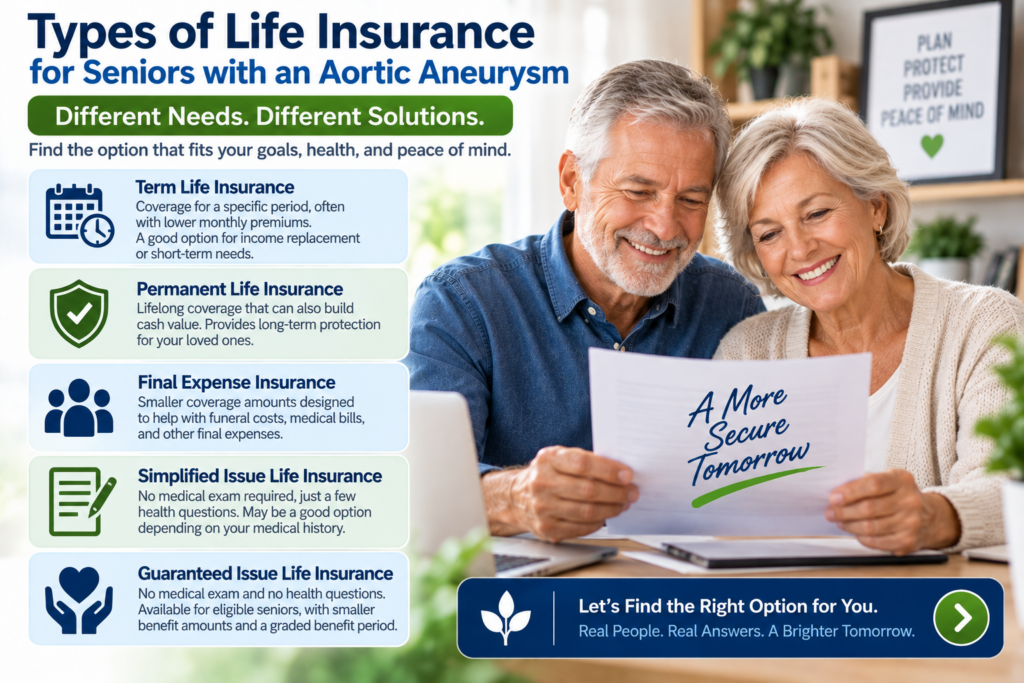
Your medical history doesn’t determine only whether you’re approved. It can also influence which type of policy makes the most sense.
Term Life Insurance
Term insurance can provide larger death benefits for a specified period.
It can be useful for:
- Mortgage protection
- Income replacement
- Spousal protection
- Estate needs
- Leaving money to children
Traditionally underwritten term insurance may be available for some applicants with small stable aneurysms or successfully repaired aneurysms.
Permanent Life Insurance
Permanent insurance or whole life insurance can provide lifelong protection as long as the policy remains in force according to its terms.
Depending on the product, it may also accumulate cash value.
Final Expense Insurance
Final expense coverage is particularly popular among seniors.
Policies typically provide smaller death benefits intended to help with:
- Funeral expenses
- Burial or cremation
- Medical bills
- Credit card balances
- Other final obligations
Underwriting may be easier than for large traditional policies.
Simplified Issue Life Insurance
Simplified issue policies don’t normally require a medical exam but do ask health questions and may use electronic medical information.
Depending on the questions and timing of your aneurysm, you may qualify.
Guaranteed Issue Life Insurance
Guaranteed issue coverage is designed for applicants who may not qualify elsewhere.
There is typically:
- No medical exam
- No health-based underwriting for eligible applicants
- Smaller coverage amounts
- Higher cost per $1,000
- A graded death benefit period for non-accidental death
I generally consider guaranteed issue a last resort, not the first place to start.
Life Insurance Companies We May Consider for an Aortic Aneurysm
There isn’t one life insurance company that’s automatically the best choice for everyone with an aortic aneurysm.
Carrier selection can depend on very specific details, including:
- Abdominal vs. thoracic aneurysm
- Exact location
- Current measurement
- Changes in size over time
- Age
- Smoking history
- Blood pressure
- Whether repair has been recommended
- EVAR, TEVAR, or open repair history
- Time since treatment
- Follow-up imaging
- Coronary artery disease
- Peripheral artery disease
- Kidney disease
- Stroke history
- Other cardiovascular conditions
Because underwriting guidelines and products can change, I don’t recommend choosing a carrier simply because you’ve heard that company is “good with aneurysms.”
Instead, I compare the applicant’s actual medical history with the companies and products available at the time.
Depending on the individual case and coverage needed, companies we may evaluate can include the following.
Mutual of Omaha
Mutual of Omaha offers multiple life insurance products for seniors, including final expense coverage.
It may be particularly useful when a senior needs smaller permanent coverage or when traditional large-face-amount insurance isn’t the best fit.
Why we may consider it: Mutual of Omaha offers several coverage options that may be relevant when comparing traditional and final expense insurance for seniors.
Protective Life
Protective can be worth considering for healthier seniors seeking larger amounts of traditionally underwritten coverage.
Someone with a successfully repaired aneurysm and a strong long-term follow-up history may warrant consideration.
Why we may consider it: Larger coverage amounts and well-documented stable histories.
Corebridge Financial
Corebridge Financial offers traditionally underwritten life insurance and can be worth evaluating when an applicant has multiple controlled cardiovascular conditions.
The complete health picture matters.
Why we may consider it: More complicated but stable medical histories.
Transamerica
Transamerica provides term and permanent life insurance products and may offer another avenue for applicants whose aneurysm history requires individual underwriting.
Best for: Seniors comparing term and permanent coverage.
Lincoln Financial
Lincoln can be particularly relevant when larger death benefits are required.
Strong cardiovascular stability and detailed medical documentation become important.
Best for: Larger traditionally underwritten policies.
North American
North American offers permanent life insurance solutions that may be worth considering for seniors seeking coverage beyond basic final expense insurance.
Best for: Permanent coverage needs.
Assurity
Assurity can provide another option when comparing life insurance products for applicants with medical histories.
Best for: Applicants seeking additional traditional or simplified alternatives.
Gerber Life
Gerber’s guaranteed life insurance can serve as a fallback for eligible seniors who can’t qualify for medically underwritten coverage.
Why we may consider it: Significant health problems requiring guaranteed issue coverage.
Don’t Pick a Carrier Based Only on Its Name
With an aortic aneurysm, underwriting strategy matters.
Before submitting an application, it can make sense for an independent agent to gather the important medical details and determine which companies are most likely to consider the case favorably.
Sample Aortic Aneurysm Life Insurance Scenarios
Because aneurysm underwriting is highly individualized, advertising a single “aortic aneurysm rate” would be misleading.
These hypothetical examples better demonstrate how cases can differ.
| Applicant | Health History | Possible Underwriting Direction |
|---|---|---|
| Age 65 | Small AAA, stable on repeated imaging, controlled BP, non-smoker | Traditional coverage may be possible |
| Age 69 | AAA monitored for several years with no significant progression | Traditional coverage may be considered |
| Age 72 | Successful EVAR several years ago, favorable follow-up | Traditional or rated coverage may be possible |
| Age 75 | TAA plus controlled hypertension and CAD | More conservative traditional underwriting or simplified options |
| Age 78 | Large aneurysm with surgery recommended | Traditional coverage may be postponed |
| Age 80 | Significant aneurysm plus multiple serious health conditions | Simplified or guaranteed issue may be more realistic |
These examples aren’t guarantees. Actual underwriting depends on the insurer and complete medical record.
Aortic Aneurysm and High Blood Pressure
High blood pressure is particularly important when an aortic aneurysm is present.
Persistently elevated blood pressure increases stress on the arterial system, so underwriters will want to know whether hypertension is well controlled.
They may review:
- Recent readings
- Medications
- Treatment compliance
- Heart function
- Kidney function
- Evidence of other vascular damage
A senior whose blood pressure remains consistently controlled generally presents a more favorable picture than someone with repeated uncontrolled readings.
Aortic Aneurysm and Coronary Artery Disease
Aortic aneurysm and coronary artery disease can occur in the same applicant, particularly when atherosclerosis and other cardiovascular risk factors are present.
Underwriters may evaluate:
- Severity of CAD
- Previous heart attack
- Stress testing
- Heart function
- Stents
- Bypass surgery
- Cholesterol
- Smoking
Having both conditions doesn’t automatically mean you’ll be declined, but it makes your overall cardiovascular picture more important.
Aortic Aneurysm and Heart Bypass Surgery
Some seniors have undergone CABG in addition to being diagnosed with an aortic aneurysm.
In that situation, insurers will consider whether cardiovascular disease is affecting multiple parts of the circulatory system.
They’ll likely review:
- Date of bypass surgery
- Number of grafts
- Heart attack history
- Ejection fraction
- Current aneurysm size
- Aneurysm stability
- Blood pressure
- Smoking history
Long-term stability after bypass surgery combined with a stable or successfully repaired aneurysm can be considerably more favorable than recent or progressive cardiovascular disease.
Aortic Aneurysm and Peripheral Artery Disease
Peripheral Artery Disease (PAD) can indicate atherosclerosis affecting arteries outside the heart.
When PAD occurs alongside an aortic aneurysm, underwriters may look more carefully for widespread vascular disease.
They may review:
- Leg circulation
- Claudication
- Peripheral stents
- Previous vascular surgery
- Diabetes
- Smoking
- Ulcers
- Amputation history
Mild, stable PAD presents a very different underwriting risk than advanced disease.
Aortic Aneurysm and Kidney Disease
Kidney disease can complicate underwriting because kidney function and cardiovascular health are closely connected.
Insurers may review:
- eGFR
- Creatinine
- Stage of chronic kidney disease
- Blood pressure
- Diabetes
- Protein in the urine
- Nephrology follow-up
Mild kidney impairment may have a relatively limited impact, while advanced CKD combined with significant vascular disease can substantially restrict traditional coverage options.
Aortic Aneurysm and Smoking
Smoking history deserves special attention in an aortic aneurysm application.
If you currently smoke, the insurance company will consider both the cardiovascular implications and tobacco pricing.
If you’ve quit, tell your agent:
- What you smoked
- How much
- How long you smoked
- Exact date you stopped
- Whether you’ve remained completely tobacco-free
Don’t assume an old smoking history automatically prevents favorable coverage.
The longer you’ve remained tobacco-free, the more relevant that history of cessation can become, subject to the insurer’s underwriting rules.
Aortic Aneurysm and Heart Valve Disease
This relationship is particularly important with certain thoracic aortic aneurysms.
Some applicants may have both an aortic abnormality and aortic valve disease.
The insurer may evaluate:
- Type of valve disorder
- Severity
- Echocardiogram results
- Ejection fraction
- Symptoms
- Aortic measurements
- Whether surgery has been recommended
- Previous valve replacement
When multiple structural heart conditions are present, carrier selection becomes especially important.
Aortic Aneurysm and Stroke History
An applicant with both an aortic aneurysm and a previous stroke will generally receive more detailed cardiovascular underwriting.
Insurers may consider:
- Date of stroke
- Cause
- Residual neurological symptoms
- Carotid artery disease
- Blood pressure
- Atrial fibrillation
- Other vascular disease
- Current medications
A remote stroke with good recovery and stable cardiovascular health may be viewed differently from a recent stroke or recurrent cerebrovascular events.
Why Your Last Two Imaging Reports Can Matter More Than You Think
When I’m gathering information from someone with an aortic aneurysm, I don’t just want to know the measurement from the most recent scan.
I also want to know what the previous scan showed.
Why?
Because the two measurements can help tell the story.
If your most recent report shows an aneurysm measurement but we don’t know what it measured a year or two earlier, we have only a snapshot.
If multiple imaging reports show that the aneurysm has remained essentially unchanged, we can provide an underwriter with evidence about its stability over time.
On the other hand, if the measurements show progression, the insurer may want additional information about your doctor’s recommendations and whether further treatment is being considered.
So before requesting quotes, I recommend trying to find:
- Your most recent aneurysm measurement
- Your previous measurement
- The dates of both imaging studies
- The type of imaging performed
- Your doctor’s current recommendation
You don’t necessarily need to obtain your entire medical file yourself. But knowing these details can help me determine which insurance companies may be worth approaching before we submit a formal application.
Aortic Aneurysm Life Insurance Case Examples
The following examples are hypothetical but illustrate how I would approach different cases.
Case Study 1: Small Stable AAA
David, age 67
David’s abdominal aortic aneurysm was discovered four years ago.
His recent imaging shows that it remains small and has demonstrated little change.
He:
- Doesn’t smoke
- Has controlled blood pressure
- Has no symptoms
- Keeps all imaging appointments
- Hasn’t been advised to undergo surgery
Possible approach: Traditionally underwritten life insurance may be worth pursuing before considering simplified coverage.
Case Study 2: Successful EVAR
Michael, age 73
Michael underwent EVAR several years ago for an abdominal aortic aneurysm.
Since the procedure:
- Follow-up imaging has been favorable
- No additional surgery has been required
- Blood pressure is controlled
- He doesn’t smoke
- He remains active
Possible approach: Depending on the complete medical history, traditionally underwritten coverage may be available.
Case Study 3: Thoracic Aneurysm With Other Heart Disease
Susan, age 75
Susan has a monitored thoracic aortic aneurysm, high blood pressure, and coronary artery disease.
Her conditions are stable, but the combination creates a more complicated underwriting profile.
Possible approach: Shop the case carefully among traditionally underwritten carriers while keeping simplified coverage available as an alternative.
Case Study 4: Surgery Has Been Recommended
Robert, age 76
Robert’s aneurysm has enlarged, and his vascular surgeon has recommended repair.
He wants to purchase life insurance before the procedure.
Possible approach: Traditional insurers may postpone consideration until the recommended treatment is completed and recovery can be evaluated.
If Robert needs immediate coverage, alternative products may need to be explored.
Case Study 5: Multiple Serious Conditions
Mary, age 81
Mary has an aortic aneurysm along with advanced kidney disease, diabetes, and significant cardiovascular disease.
Possible approach: Traditional coverage may be difficult. Simplified issue or guaranteed issue final expense insurance may be more realistic.
Why an Independent Agent Matters With an Aortic Aneurysm
An aortic aneurysm is exactly the type of medical history where applying randomly to insurance companies can create problems.
The diagnosis alone doesn’t tell the whole story.
Before approaching a carrier, I want to know:
- AAA or TAA?
- Exact location?
- Current size?
- Previous size?
- Growing or stable?
- When was your last scan?
- Has surgery been recommended?
- Has repair already occurred?
- EVAR, TEVAR, or open repair?
- Any complications?
- Do you smoke?
- Is your blood pressure controlled?
- Do you have CAD, PAD, diabetes, kidney disease, or other cardiovascular conditions?
With that information, I can compare your situation with multiple life insurance companies instead of simply submitting an application and hoping for the best.
As an independent life insurance agent, I’m not tied to one carrier.
That matters because different companies can reach very different decisions on the same medical history.
The objective isn’t merely finding a company willing to issue a policy.
It’s finding the company most likely to offer the best combination of approval, coverage, and price for your individual situation.
And there is no additional fee to you for using an independent agent. Agents are compensated by the insurance company when coverage is placed.
Key Takeaways About Life Insurance With an Aortic Aneurysm
If you remember only a few things from this guide, remember these:
- An aortic aneurysm doesn’t automatically make you uninsurable.
- Both abdominal aortic aneurysms (AAA) and thoracic aortic aneurysms (TAA) may be considered for life insurance.
- The exact measurement and change over time can be more useful than simply describing an aneurysm as small or large.
- Regular imaging and specialist follow-up help document whether the aneurysm is stable.
- An unrepaired aneurysm may still be considered when your physician believes continued surveillance is appropriate.
- Life insurance may also be possible after EVAR, TEVAR, or open aneurysm repair.
- Recent surgery, an aneurysm awaiting recommended repair, significant growth, uncontrolled blood pressure, smoking, or additional cardiovascular disease can make traditional underwriting more difficult.
- Simplified issue and guaranteed issue coverage may provide alternatives when traditionally underwritten coverage isn’t available.
- Different life insurance companies can evaluate the same medical history differently.
The most useful first step isn’t guessing whether you’ll qualify. It’s gathering the details of your aneurysm and comparing your situation with multiple insurance companies.
Medical Sources and Further Reading
Medical information in this guide has been informed by resources from the National Heart, Lung, and Blood Institute (NHLBI/NIH), American Heart Association, Cleveland Clinic, and Society for Vascular Surgery. These sources provide additional information about aortic aneurysm diagnosis, monitoring, risk factors, and treatment.
- NHLBI — Aortic Aneurysm Overview
- American Heart Association — What Is an Aneurysm?
- Cleveland Clinic — Aortic Aneurysm
- Society for Vascular Surgery — Abdominal Aortic Aneurysm
Frequently Asked Questions About Life Insurance With an Aortic Aneurysm
Can you get life insurance with an aortic aneurysm?
Yes. Some applicants with small, stable aneurysms or successfully repaired aneurysms can qualify for traditionally underwritten life insurance. More serious cases may require simplified issue or guaranteed issue coverage
Will an aortic aneurysm automatically cause a life insurance decline?
No. Underwriters consider the aneurysm’s location, size, stability, treatment status, symptoms, and your overall cardiovascular health.
Does the size of an aortic aneurysm affect life insurance?
Yes. Size is an important underwriting factor, but there isn’t one measurement used universally by every insurance company. Growth rate, location, treatment recommendations, and overall health also matter.
Can I get life insurance with an unrepaired AAA?
Potentially. A small abdominal aortic aneurysm that is stable and appropriately monitored can sometimes qualify for traditional coverage.
Can I get life insurance after AAA repair?
Yes. Successful repair followed by favorable imaging and long-term stability can make traditional coverage possible depending on your overall health.
Can I get life insurance after EVAR?
Potentially, yes. Underwriters will want information about the procedure, recovery, follow-up imaging, and any complications.
Can I get life insurance after TEVAR?
Yes, depending on the reason for the procedure and your subsequent medical history. Stable post-operative results are important.
How long after aneurysm surgery should I apply?
There isn’t a universal waiting period. Many traditional carriers want recovery to be complete and post-operative testing available before making an offer.
What if my aneurysm hasn’t changed in years?
That’s potentially favorable information. Long-term stability can help an underwriter understand the current risk more accurately.
What if my doctor is only monitoring my aneurysm?
That’s common. Make sure you remain current with all recommended imaging because those records can demonstrate that the condition is stable and appropriately managed.
What if surgery has been recommended but I haven’t had it yet?
Traditional life insurance may be difficult until the recommended treatment is completed. An insurer may postpone the application rather than issue coverage while significant treatment is pending.
Does high blood pressure affect approval?
It can. Controlled blood pressure is generally more favorable, particularly because hypertension can increase cardiovascular risk.
Does smoking affect life insurance with an aortic aneurysm?
Yes. Smoking can significantly complicate the underwriting picture and also affect the tobacco rate class you’re eligible for.
What if I have an aneurysm and coronary artery disease?
You may still qualify, but the insurer will evaluate the conditions together to determine your overall cardiovascular risk.
What if I had bypass surgery too?
Coverage can still be possible. The insurer will review your CABG history, heart function, aneurysm history, current imaging, and other cardiovascular factors.
Will I need a medical exam?
Not necessarily. Fully underwritten policies may require an exam or medical records, while simplified issue and guaranteed issue products generally have different requirements.
Should I apply for guaranteed issue insurance first?
Usually not if you may qualify for better coverage.
Guaranteed issue can be valuable for people with serious health problems, but it commonly has smaller benefits, higher costs per $1,000, and a graded benefit period.
It’s generally better to determine whether traditional or simplified coverage is available first.
What is the best life insurance company for an aortic aneurysm?
There isn’t one company that’s best for everyone. The right carrier depends on the location and size of your aneurysm, stability, treatment history, age, other medical conditions, and desired coverage.
Questions to Answer Before Requesting a Quote
If you have an aortic aneurysm and want me to compare life insurance options, having the following information ready can save considerable time:
- Your age
- State of residence
- AAA or TAA
- Exact location
- Current aneurysm measurement
- Previous measurement
- Date of most recent imaging
- Whether the aneurysm is stable or growing
- Whether surgery has been recommended
- Type and date of repair, if applicable
- Any complications
- Current medications
- Blood pressure
- Smoking status
- Coronary artery disease history
- Heart attack history
- Stent or bypass history
- PAD
- Stroke history
- Diabetes
- Kidney disease
- Desired amount of life insurance
The more accurately we understand your medical history before submitting an application, the better we can target the companies most likely to consider it favorably.
Final Thoughts: An Aortic Aneurysm Doesn’t Automatically Mean You Can’t Get Life Insurance
An aortic aneurysm is a serious medical condition, and life insurance companies will evaluate it carefully.
But the words “aortic aneurysm” don’t tell an underwriter enough to make a decision.
What really matters is the complete picture.
A small AAA that has remained stable for years isn’t the same as an aneurysm that’s rapidly enlarging.
A successfully repaired aneurysm with years of favorable follow-up isn’t the same as an aneurysm awaiting surgery.
And a healthy non-smoker with controlled blood pressure isn’t necessarily evaluated the same way as someone with several additional vascular conditions.
That’s why I don’t recommend assuming you’ll be declined—or automatically buying guaranteed issue coverage—before your case has been properly evaluated.
Ready to Find Out What You Qualify For?

If you’ve been diagnosed with an abdominal or thoracic aortic aneurysm, or you’ve already undergone EVAR, TEVAR, or open aneurysm repair, there may be more life insurance options available than you think.
As an independent life insurance agent, I can compare multiple companies based on your actual health history rather than forcing you into a one-size-fits-all policy.
Get your free, no-obligation quote today and let us find the life insurance companies most likely to work with your aortic aneurysm history.
Coverage availability, underwriting decisions, rates, and policy features vary by insurer, state, age, health history, and individual circumstances. Examples in this article are illustrative and aren’t guarantees of approval or a particular rate.