Life Insurance for Seniors with Parkinson’s Disease: Approval Tips, Rates & Best Companies (2026 Guide)
 Posted in Senior Life Insurance on June 10, 2026 last updated on June 10, 2026
Is Life Insurance for Seniors with Parkinson’s Disease Possible?
Yes, many seniors with Parkinson’s disease can still qualify for life insurance.
However, approval opportunities and pricing often depend on several factors, including the stage of Parkinson’s disease, symptom severity, mobility, medication history, overall health, and whether other medical conditions are present.
Many people assume that a Parkinson’s diagnosis automatically results in a life insurance decline. While advanced cases can make traditional underwriting more difficult, many seniors with mild to moderate Parkinson’s disease are still able to obtain coverage.
The key is understanding how insurance companies evaluate Parkinson’s disease and identifying the carriers that may be more favorable for your specific situation.
Depending on your health profile, available options may include:
The best option depends on your age, symptoms, mobility, medications, and overall health.
Quick Answer
If you’re looking for the short version:
- Many seniors with Parkinson’s disease can qualify for life insurance.
- Early-stage Parkinson’s often receives the most favorable underwriting consideration.
- Insurance companies review mobility, medications, progression, and cognitive function.
- Traditional coverage may still be available for mild cases.
- Advanced Parkinson’s may require simplified issue or final expense insurance.
- Comparing multiple companies is critical because underwriting guidelines vary significantly.
- Having Parkinson’s does not automatically mean you will be declined.
What Is Parkinson’s Disease?
Parkinson’s disease is a progressive neurological disorder that affects movement, balance, coordination, and muscle control.
The condition develops when nerve cells in the brain gradually stop producing adequate amounts of dopamine, a chemical responsible for helping control movement.
Common symptoms may include:
- Tremors
- Muscle stiffness
- Slowed movement
- Balance problems
- Walking difficulties
- Speech changes
- Fatigue
- Cognitive changes
Symptoms and progression vary significantly from person to person.
Some seniors experience mild symptoms for many years, while others may experience more rapid progression.
Because of these differences, life insurance companies evaluate Parkinson’s disease on a case-by-case basis.
How Life Insurance Companies Evaluate Parkinson’s Disease
Insurance companies focus less on the diagnosis itself and more on how the condition affects daily life.
Several factors play a major role in underwriting decisions.
Age at Diagnosis
One of the first questions underwriters often review is when Parkinson’s disease was diagnosed.
Generally speaking:
- Later diagnoses may receive more favorable consideration.
- Earlier diagnoses may suggest a longer progression timeline.
- Recently diagnosed applicants often receive closer review.
Disease Progression
Insurance companies frequently evaluate:
- How quickly symptoms have progressed
- Whether symptoms remain stable
- Frequency of medical visits
- Neurologist reports
- Hospitalizations
Stable cases often receive more favorable underwriting outcomes.
Mobility
Mobility is one of the most important underwriting factors.
Insurance companies may ask:
- Can you walk independently?
- Do you use a cane?
- Do you use a walker?
- Have you experienced falls?
- Can you perform normal daily activities?
Applicants who remain independent generally have more coverage options available.
Cognitive Function
Some Parkinson’s patients experience memory or cognitive changes.
Insurance companies may review:
- Memory concerns
- Dementia diagnoses
- Cognitive testing
- Ability to manage daily activities
Cognitive impairment often receives additional underwriting attention.
Medications
Common medications include:
- Levodopa
- Carbidopa-Levodopa
- Pramipexole
- Ropinirole
- Selegiline
Medication history often helps insurers understand disease severity and control.
Parkinson’s Disease Severity Levels and Life Insurance Approval Chances
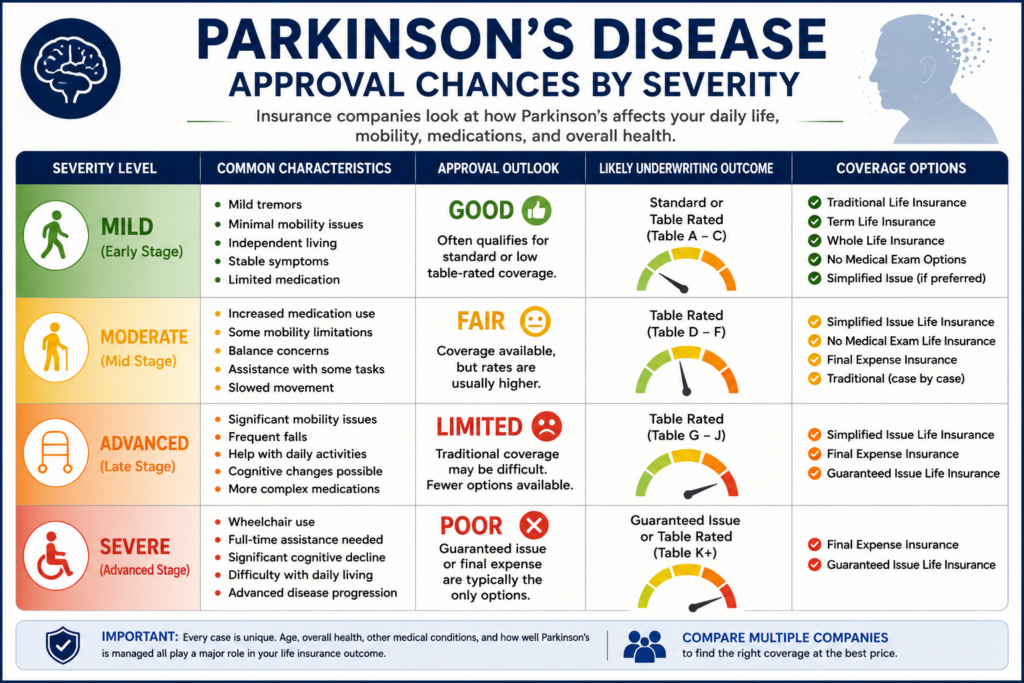
Not every Parkinson’s diagnosis is treated the same.
The stage of the disease often has a significant impact on underwriting outcomes.
Mild Parkinson’s Disease
Characteristics may include:
- Mild tremors
- Minimal mobility issues
- Independent living
- Stable symptoms
- Limited medication requirements
Life Insurance Outlook
Many applicants still qualify for traditional life insurance and may receive standard or table-rated offers.
Moderate Parkinson’s Disease
Characteristics may include:
- Increased medication use
- Some mobility limitations
- Balance concerns
- Slower movement
- Assistance with certain activities
Life Insurance Outlook
Coverage is often available, although premiums may be higher and some companies may limit options.
Advanced Parkinson’s Disease
Characteristics may include:
- Significant mobility challenges
- Frequent falls
- Assistance with daily activities
- Cognitive concerns
- Extensive medical management
Life Insurance Outlook
Traditional underwriting becomes more difficult. Simplified issue, final expense, and guaranteed issue policies often become the primary options.
Severe Parkinson’s Disease
Characteristics may include:
- Wheelchair use
- Significant cognitive impairment
- Full-time assistance
- Advanced progression
Life Insurance Outlook
Guaranteed issue and final expense insurance are often the most realistic coverage options.
| Parkinson’s Severity | Traditional Coverage | Simplified Issue | Guaranteed Issue |
|---|---|---|---|
| Mild | Excellent | Available | Available |
| Moderate | Good | Excellent | Available |
| Advanced | Limited | Good | Excellent |
| Severe | Rare | Limited | Excellent |
What Underwriting Class Can You Qualify For With Parkinson’s Disease?
Many seniors want to know how Parkinson’s disease affects life insurance rates.
The answer depends on several factors, including age at diagnosis, symptom severity, mobility, medication history, cognitive function, and overall health.
Standard Rating
Possible for:
- Early-stage Parkinson’s disease
- Stable symptoms
- Independent living
- No significant cognitive impairment
- Good overall health
Table Rated
Common for:
- Moderate Parkinson’s disease
- Long-term medication use
- Mild mobility limitations
- Additional health conditions
Many applicants with Parkinson’s disease who qualify for traditional coverage receive table-rated offers rather than standard rates.
Simplified Issue
Common for:
- Moderate to advanced Parkinson’s disease
- Older applicants
- Applicants seeking faster approval
- Individuals who want to avoid a medical exam
Guaranteed Issue
Often considered when:
- Traditional underwriting is unavailable
- Significant mobility limitations exist
- Cognitive impairment is present
- Multiple serious health conditions are involved
Best Life Insurance Options for Seniors With Parkinson’s Disease
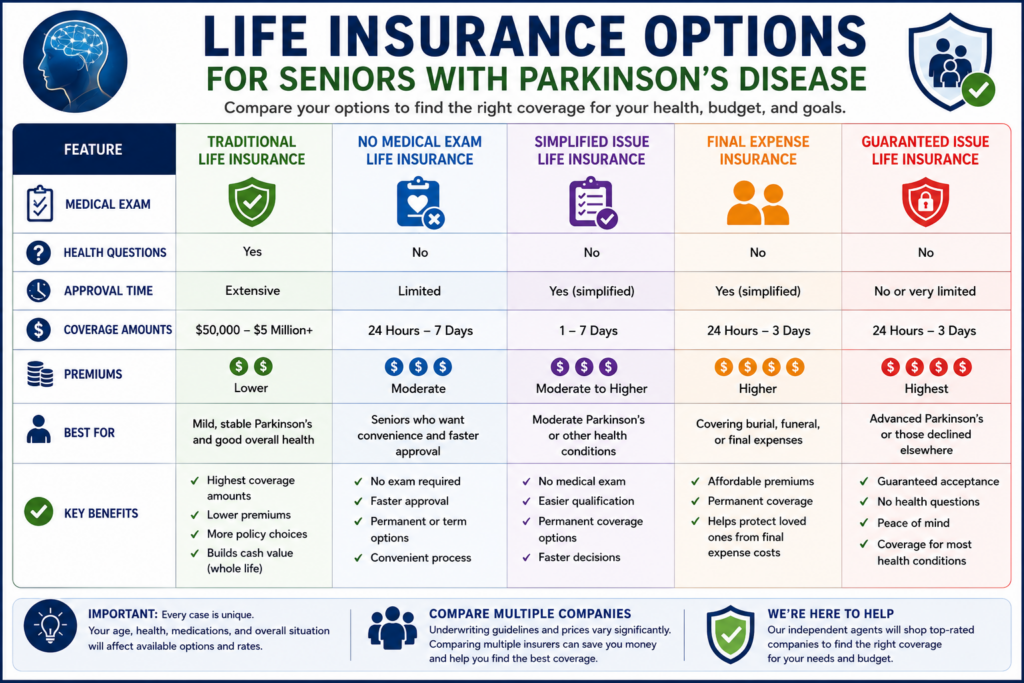
Traditional Life Insurance
Some seniors with early-stage Parkinson’s disease still qualify for traditional underwriting.
Advantages:
- Higher coverage amounts
- Lower premiums
- More policy flexibility
Best For:
- Mild Parkinson’s disease
- Stable symptoms
- Good overall health
No Medical Exam Life Insurance
Many companies now offer coverage without requiring bloodwork or a physical exam.
Advantages:
- Faster approval
- No medical exam
- Simplified process
Best For:
- Mild to moderate Parkinson’s disease
- Seniors seeking convenience
Simplified Issue Life Insurance
These policies rely on health questions but no medical exam.
Advantages:
- Easier qualification
- Faster decisions
- Permanent coverage options
Best For:
- Moderate Parkinson’s disease
- Seniors with multiple health conditions
Final Expense Insurance
Final expense insurance is often one of the most accessible options for seniors with Parkinson’s disease.
Advantages:
- Permanent coverage
- Easier underwriting
- Fixed premiums
- Funeral expense protection
Guaranteed Issue Life Insurance
Guaranteed issue policies accept virtually everyone.
Advantages:
- No health questions
- No medical exam
- Guaranteed acceptance
Disadvantages:
- Higher premiums
- Lower coverage amounts
- Waiting periods may apply
Best Life Insurance Companies for Seniors With Parkinson’s Disease
Not every company evaluates Parkinson’s disease the same way.
Some insurers are considerably more flexible than others.
Mutual of Omaha
Best For:
- Final expense coverage
- Seniors ages 50-85
- Moderate health concerns
Foresters Financial
Best For:
- Simplified issue policies
- Faster approvals
- Moderate Parkinson’s disease
Americo
Best For:
- Multiple health conditions
- Final expense insurance
- Flexible underwriting
Prudential
Best For:
- Mild Parkinson’s disease
- Larger coverage amounts
- Traditional underwriting
Protective
Best For:
- Strong overall health
- Competitive pricing
- Term life insurance
Corebridge Financial (AIG)
Best For:
- Guaranteed issue coverage
- Advanced Parkinson’s disease
- Applicants declined elsewhere
Sample Life Insurance Rates for Seniors With Parkinson’s Disease
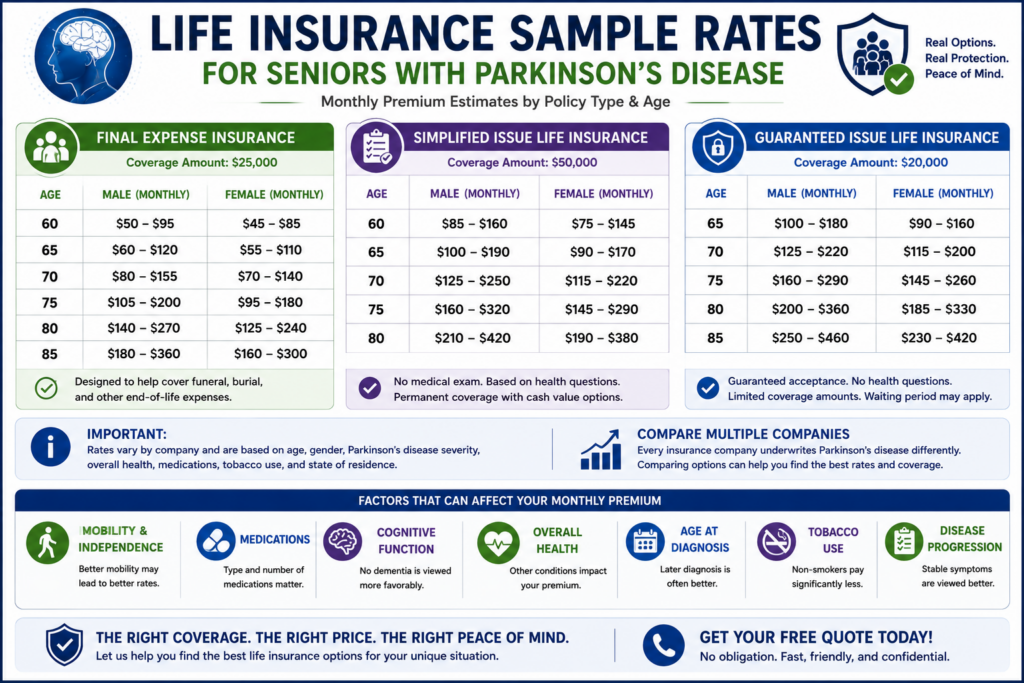
The life insurance rates below are for educational purposes only.
Actual rates depend on age, gender, disease severity, mobility, medications, tobacco use, and overall health.
Sample Final Expense Rates
| Age | Coverage | Estimated Monthly Premium |
|---|---|---|
| 60 | $25,000 | $50-$95 |
| 65 | $25,000 | $60-$120 |
| 70 | $25,000 | $80-$155 |
| 75 | $25,000 | $105-$200 |
| 80 | $25,000 | $140-$270 |
Sample Simplified Issue Rates
| Age | Coverage | Estimated Monthly Premium |
|---|---|---|
| 60 | $50,000 | $85-$160 |
| 65 | $50,000 | $100-$190 |
| 70 | $50,000 | $125-$250 |
| 75 | $50,000 | $160-$320 |
Sample Guaranteed Issue Rates
| Age | Coverage | Estimated Monthly Premium |
|---|---|---|
| 65 | $20,000 | $100-$180 |
| 70 | $20,000 | $125-$220 |
| 75 | $20,000 | $160-$290 |
| 80 | $20,000 | $200-$360 |
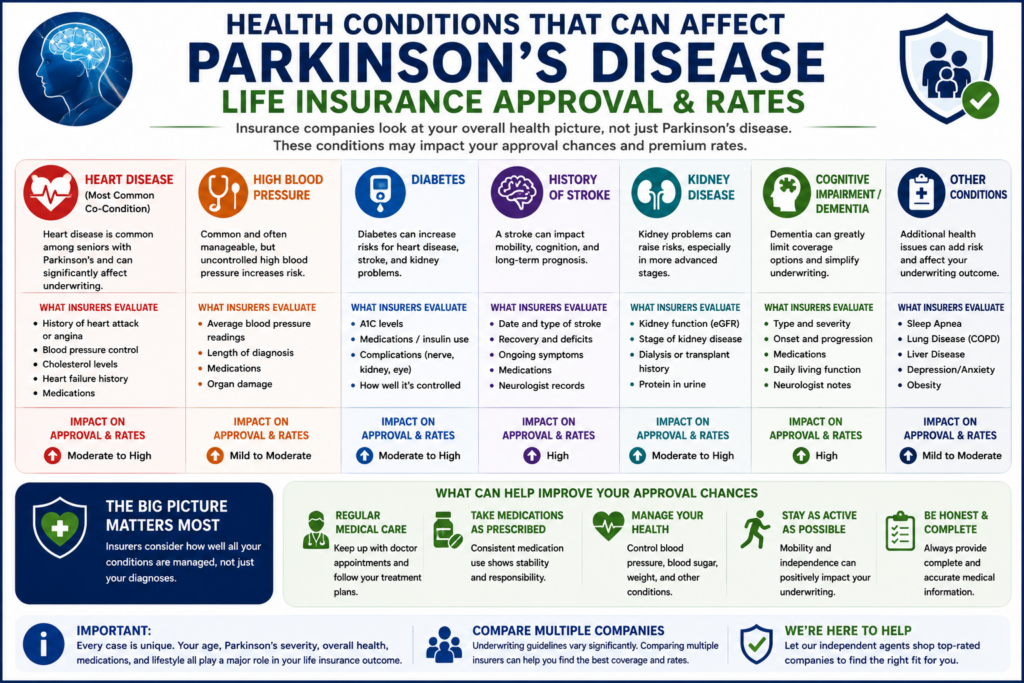
Parkinson’s Disease and Dementia
One of the most important factors insurance companies evaluate is whether cognitive impairment has developed.
Some individuals with Parkinson’s disease eventually experience:
- Memory loss
- Cognitive decline
- Difficulty managing daily activities
- Parkinson’s disease dementia
When dementia is present, underwriting becomes significantly more challenging.
Insurance companies often review:
- Neurologist records
- Cognitive testing
- Medication history
- Ability to perform daily activities
Many seniors with mild cognitive changes still qualify for coverage, while advanced dementia often limits available options.
Parkinson’s Disease and Stroke
Parkinson’s disease and stroke are separate conditions, but both can affect mobility and neurological function.
Insurance companies may evaluate:
- Previous stroke history
- Recovery outcomes
- Mobility limitations
- Rehabilitation progress
- Current neurological status
Applicants with both Parkinson’s disease and a history of stroke often receive additional underwriting review.
Parkinson’s Disease and Heart Disease
Heart disease frequently occurs alongside Parkinson’s disease in older adults.
Insurance companies often review:
- Heart attack history
- Blood pressure control
- Cholesterol levels
- Heart failure history
- Cardiovascular medications
In many cases, cardiovascular health has as much impact on underwriting as Parkinson’s disease itself.
Parkinson’s Disease and Diabetes
Diabetes is another common condition among seniors applying for life insurance.
Insurance companies may review:
- A1C levels
- Medication usage
- Kidney function
- Neuropathy
- Overall disease control
Well-controlled diabetes generally leads to more favorable underwriting outcomes than poorly controlled diabetes.
Parkinson’s Disease and Multiple Health Conditions
Many seniors with Parkinson’s disease also have additional medical concerns.
Examples include:
- Diabetes
- Heart disease
- High blood pressure
- Sleep apnea
- Kidney disease
- Obesity
Insurance companies typically evaluate the entire health picture rather than focusing on a single diagnosis.
For many applicants, the combination of multiple conditions has a larger impact on underwriting than Parkinson’s disease alone.
Real-Life Example
A 71-year-old applicant contacted us after being told by another insurance agent that Parkinson’s disease would likely prevent him from qualifying for affordable life insurance.
He had been diagnosed approximately five years earlier and was managing his symptoms with medication and regular neurologist visits.
His health profile included:
- Parkinson’s disease
- Controlled high blood pressure
- No history of stroke
- No dementia diagnosis
- Independent living
- Non-smoker
Like many seniors, he assumed that a neurological condition automatically meant life insurance was out of reach.
Fortunately, that wasn’t the case.
After reviewing his medical history, we found several factors that worked in his favor:
- Stable symptoms
- Consistent medication compliance
- No significant cognitive impairment
- Independent mobility
- No recent hospitalizations
- Strong overall health for his age
Rather than applying with a single insurance company, we compared multiple carriers with experience underwriting applicants with chronic health conditions.
Several companies declined to offer competitive terms, but others viewed his situation much more favorably.
Ultimately, he was approved for coverage that provided financial protection for his family at a premium that was significantly lower than he expected.
The experience highlights an important lesson:
A Parkinson’s diagnosis alone does not determine your life insurance outcome.
Insurance companies evaluate the severity of the condition, how well it is controlled, and the overall health profile of the applicant.
For many seniors, the right insurance company can make a substantial difference in both approval chances and pricing.

Tips to Improve Approval Chances
While no strategy can guarantee approval, several steps may help improve underwriting outcomes.
Work With an Independent Agent
Different companies evaluate Parkinson’s disease differently.
An independent agent can compare multiple carriers instead of relying on a single company’s guidelines.
Maintain Regular Medical Care
Insurance companies prefer applicants who actively manage their health.
Regular appointments with your neurologist can demonstrate stability and treatment compliance.
Follow Medication Recommendations
Medication compliance often plays a significant role in underwriting decisions.
Underwriters want to see that symptoms are being actively managed.
Apply Before Symptoms Progress
Coverage options are generally broader when Parkinson’s disease is in the earlier stages.
Waiting until mobility or cognitive issues become more severe may limit available choices.
Be Honest on Your Application
Always disclose diagnoses, medications, and medical history accurately.
Incomplete information can lead to delays, policy rescissions, or denials.
Helpful Resources
You may also find these guides helpful:
Frequently Asked Questions
Can you get life insurance if you have Parkinson’s disease?
Yes. Many seniors with Parkinson’s disease can still qualify for life insurance. Approval depends on factors such as symptom severity, mobility, medications, cognitive function, and overall health.
Will Parkinson’s disease increase life insurance rates?
In many cases, yes. Parkinson’s disease often results in additional underwriting review and may lead to higher premiums compared to applicants without neurological conditions.
Can I get life insurance without a medical exam?
Yes. Many seniors with Parkinson’s disease choose simplified issue or no medical exam life insurance options.
Is Parkinson’s disease considered a high-risk condition?
Insurance companies generally consider Parkinson’s disease a higher-risk condition than many common medical issues. However, mild and stable cases often remain insurable.
What if I have Parkinson’s disease and dementia?
The presence of dementia can significantly affect underwriting outcomes and may reduce available coverage options.
What is the easiest life insurance policy to qualify for with Parkinson’s disease?
Final expense insurance and guaranteed issue life insurance are often among the easiest policies to qualify for.
Can I qualify if I use a walker or cane?
Possibly. Many companies evaluate mobility limitations individually. Using a cane or walker does not automatically result in a decline.
Can I get life insurance after being declined elsewhere?
Yes. Different companies use different underwriting guidelines. A decline from one carrier does not necessarily mean another company will make the same decision.
Get Personalized Life Insurance Quotes — Even With Parkinson’s Disease
Having Parkinson’s disease does not automatically prevent you from getting life insurance.
Many seniors are surprised to learn they still qualify for coverage, even after receiving a Parkinson’s diagnosis.
The key is finding the right insurance company.
Every insurer evaluates Parkinson’s disease differently. One company may decline an application while another may offer affordable coverage options.
That’s why Rob and Tracy Pinner compare multiple life insurance companies on your behalf.
We Can Help You Compare:
✅ Traditional Life Insurance
✅ No Medical Exam Life Insurance
✅ Simplified Issue Life Insurance
✅ Final Expense Insurance
✅ Guaranteed Issue Life Insurance
Get Help If You Have:
- Parkinson’s Disease
- Mobility Limitations
- Tremors
- Balance Issues
- High Blood Pressure
- Diabetes
- Heart Disease
- Stroke History
- Multiple Health Conditions
Don’t assume you have run out of options.
Request a personalized quote today and discover which companies may offer the best rates and approval opportunities for your unique health profile.
Get Your Free Life Insurance Quote Today

Why Trust Really Smart Insurance?
Really Smart Insurance specializes in helping seniors compare life insurance options across multiple insurance companies.
We regularly assist applicants with:
- Parkinson’s Disease
- Heart Disease
- Diabetes
- Kidney Disease
- Sleep Apnea
- High Blood Pressure
- Obesity
- Stroke History
- Multiple Health Conditions
Because we are independent agents, we can compare multiple carriers to help identify companies that may offer better rates and approval opportunities based on your specific medical history.
Final Thoughts
A Parkinson’s disease diagnosis can feel overwhelming, but it does not automatically eliminate your life insurance options.
Many seniors with mild to moderate Parkinson’s disease still qualify for coverage, particularly when symptoms are stable and overall health is well managed.
The key is understanding how insurance companies evaluate neurological conditions, exploring all available policy types, and comparing multiple carriers.
Whether you’re seeking term life insurance, whole life insurance, final expense insurance, or guaranteed issue coverage, there may be more options available than you expect.
By working with an independent agency that understands Parkinson’s underwriting, you can improve your chances of finding affordable coverage that helps protect your loved ones and preserve your financial legacy.