Life Insurance for Seniors With Alzheimer’s Disease: Approval Tips, Rates & Best Options (2026 Guide)
 Posted in Final Expense Life Insurance on June 13, 2026 last updated on June 13, 2026
Is Life Insurance for Seniors with Alzheimer’s Disease possible?
Yes, some seniors with Alzheimer’s disease can still qualify for life insurance, but approval options often depend on how advanced the condition is and when the diagnosis occurred.
Many families assume that an Alzheimer’s diagnosis automatically means life insurance is no longer available. While advanced Alzheimer’s can make traditional coverage difficult to obtain, many seniors in the early stages of the disease still have options.
Depending on the situation, available coverage may include:
- Traditional Life Insurance
- No Medical Exam Life Insurance
- Simplified Issue Life Insurance
- Final Expense Insurance
- Guaranteed Issue Life Insurance
The key factors insurance companies evaluate include cognitive function, diagnosis date, overall health, medications, and the ability to perform daily living activities independently.
If you or a loved one has Alzheimer’s disease, understanding how insurance companies evaluate the condition can help you find the best available coverage.
Quick Answer
If you’re looking for the short version:
- Early-stage Alzheimer’s may still qualify for some life insurance options.
- Recent diagnoses generally receive more favorable consideration than advanced disease.
- Traditional life insurance becomes more difficult as the disease progresses.
- Final expense insurance is often the most practical solution for many families.
- Guaranteed issue life insurance remains available even when other options are not.
What Is Alzheimer’s Disease?
Alzheimer’s disease is a progressive neurological disorder that affects memory, thinking, reasoning, and behavior.
It is the most common cause of dementia among older adults.
Symptoms often begin gradually and may include:
- Memory loss
- Difficulty finding words
- Confusion
- Changes in judgment
- Difficulty completing familiar tasks
- Personality changes
As the disease progresses, individuals may require increasing levels of assistance with everyday activities.
Because Alzheimer’s affects life expectancy and independence, insurance companies evaluate the condition carefully during the underwriting process.
How Life Insurance Companies Evaluate Alzheimer’s Disease
Insurance companies focus on several key factors when reviewing life insurance for seniors with Alzheimer’s Disease.
Stage of Alzheimer’s Disease
The severity of the disease is often the most important underwriting factor.
Companies typically consider:
- Early-stage Alzheimer’s
- Mild Alzheimer’s
- Moderate Alzheimer’s
- Advanced Alzheimer’s
The earlier the stage, the more options may be available.
Date of Diagnosis
Insurance companies often ask:
- When were you diagnosed?
- How quickly has the condition progressed?
- Have symptoms remained stable?
A recent diagnosis with mild symptoms may be viewed differently than a diagnosis made several years ago.
Cognitive Function
Underwriters may review:
- Memory evaluations
- Neurological testing
- Physician notes
- Cognitive assessments
Evidence of stable cognitive function can improve approval opportunities.
Daily Living Activities
Insurance companies often evaluate whether the applicant can independently perform:
- Bathing
- Dressing
- Eating
- Transferring
- Toileting
- Maintaining personal hygiene
Loss of independence may significantly affect available coverage options.
Medications
Common Alzheimer’s medications include:
- Donepezil (Aricept)
- Memantine (Namenda)
- Rivastigmine (Exelon)
Medication use may provide insight into the severity and progression of the disease.
Alzheimer’s Disease Severity Levels and Approval Chances
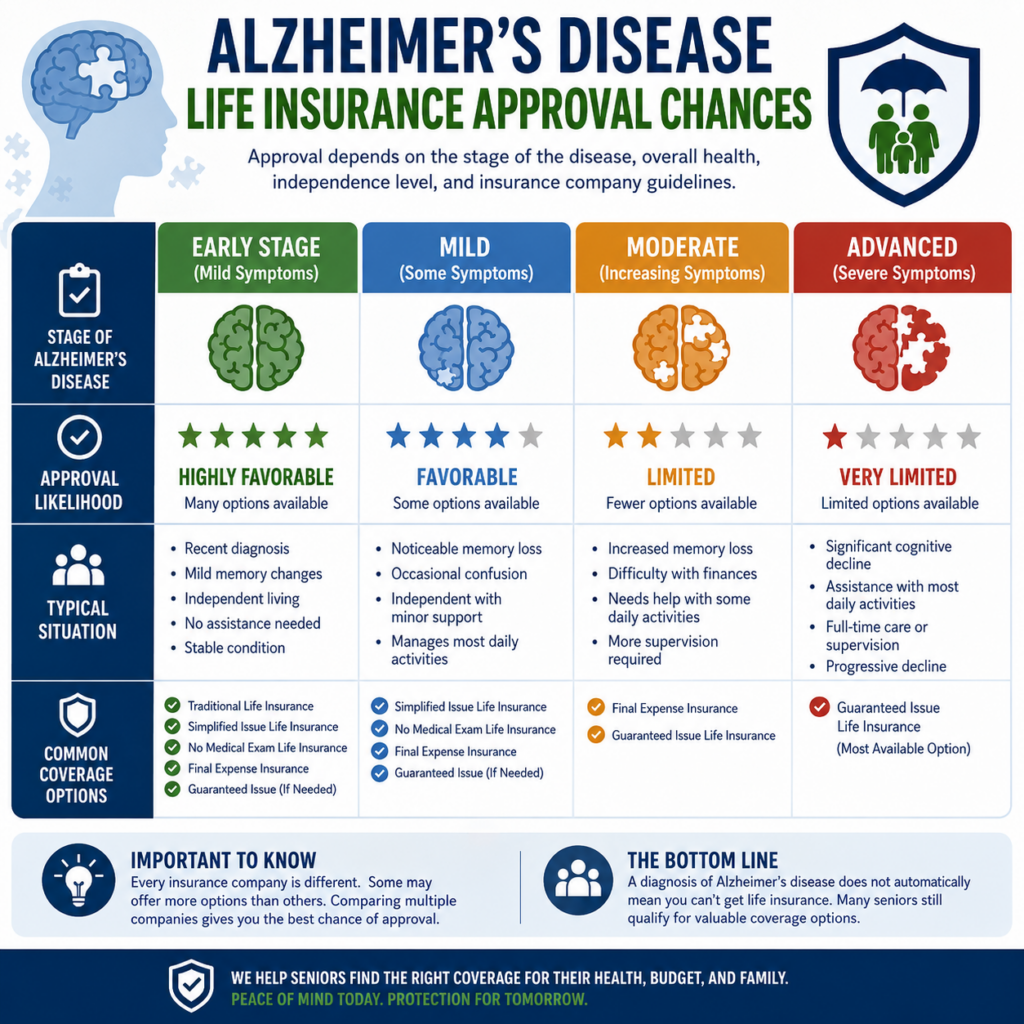
Early-Stage Alzheimer’s
Characteristics:
- Mild memory loss
- Independent living
- Minimal assistance needed
- Recent diagnosis
Life Insurance Outlook
Some traditional and simplified issue options may still be available.
Mild Alzheimer’s
Characteristics:
- Noticeable memory issues
- Occasional confusion
- Independent with minor support
Life Insurance Outlook
Coverage may still be available through select insurers, although underwriting becomes more restrictive.
Moderate Alzheimer’s
Characteristics:
- Increased memory impairment
- Difficulty managing finances
- Greater supervision required
Life Insurance Outlook
Traditional coverage becomes much more difficult. Final expense insurance may offer better opportunities.
Advanced Alzheimer’s
Characteristics:
- Significant cognitive decline
- Assistance with daily activities
- Full-time supervision
Life Insurance Outlook
Guaranteed issue life insurance is often the primary option.
Alzheimer’s Disease Severity and Coverage Options
| Severity | Traditional Life Insurance | Simplified Issue | Final Expense | Guaranteed Issue |
|---|---|---|---|---|
| Early Stage | Excellent | Excellent | Available | Available |
| Mild | Limited | Good | Excellent | Available |
| Moderate | Rare | Limited | Excellent | Excellent |
| Advanced | Unavailable | Rare | Limited | Excellent |
Why Alzheimer’s Disease Makes Life Insurance More Challenging
Insurance companies evaluate risk based on life expectancy and future health outcomes.
Alzheimer’s disease is progressive, meaning symptoms generally worsen over time.
Insurance companies may have concerns regarding:
- Increasing care needs
- Reduced life expectancy
- Future cognitive decline
- Additional medical complications
- Long-term care requirements
However, a diagnosis alone does not always eliminate coverage opportunities.
Every insurance company has different underwriting guidelines.
Best Life Insurance Options for Seniors With Alzheimer’s Disease
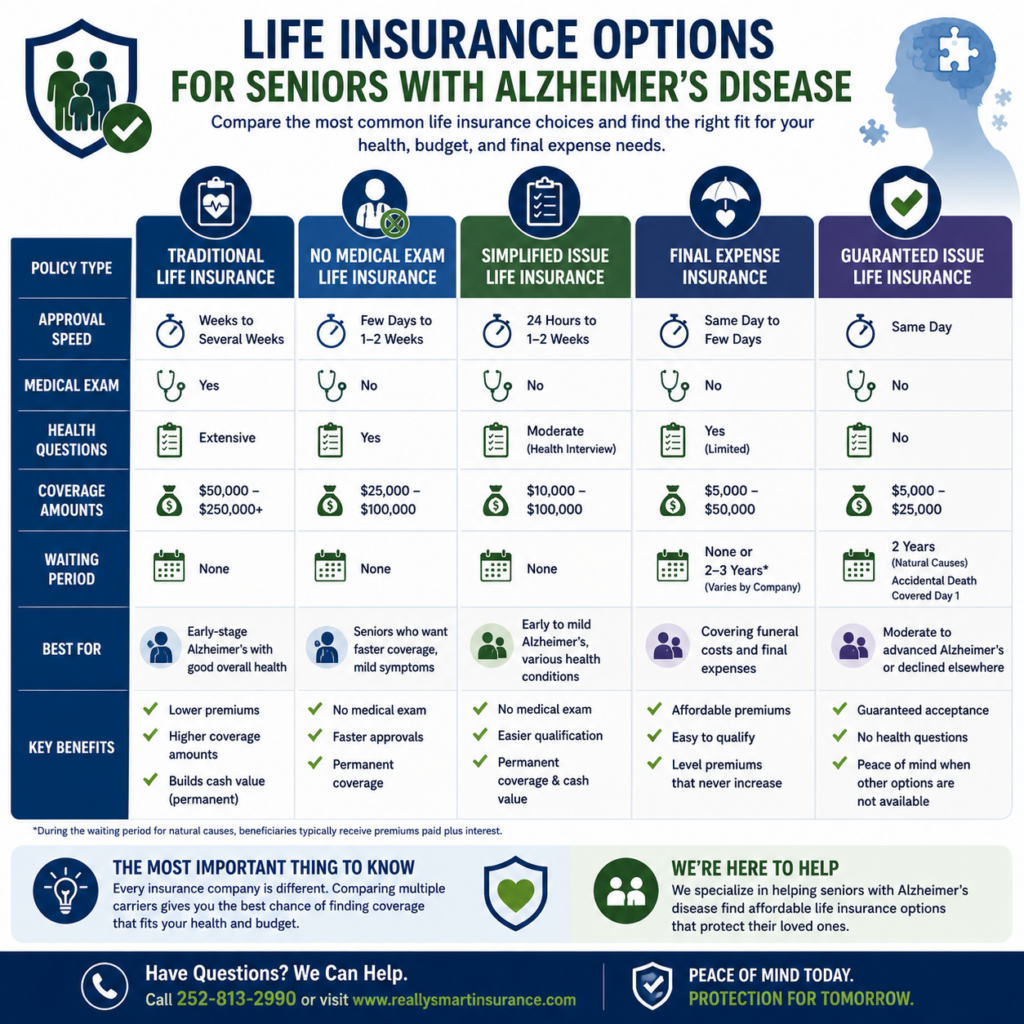
Final Expense Insurance
Final expense insurance is often one of the most practical options for families dealing with Alzheimer’s disease.
Advantages include:
- Permanent coverage
- Smaller coverage amounts
- Easier qualification
- Fixed premiums
- Coverage for funeral expenses and final bills
Many policies offer coverage amounts ranging from $5,000 to $50,000.
Guaranteed Issue Life Insurance
Guaranteed issue policies accept nearly everyone within eligible age ranges.
Advantages include:
- No health questions
- No medical exam
- Guaranteed acceptance
Disadvantages include:
- Higher premiums
- Lower coverage amounts
- Waiting periods may apply
Simplified Issue Life Insurance
Some seniors with very early-stage Alzheimer’s may still qualify for simplified issue life insurance.
Advantages include:
- Faster approvals
- No medical exam
- Permanent coverage options
Qualification depends heavily on the severity and progression of symptoms.
Check out the difference between simplified issue and guaranteed issue life.
No Medical Exam Life Insurance
While some no-exam policies still review medical records, certain applicants with very mild symptoms may qualify depending on the insurer.
For many families, final expense insurance ultimately becomes the most practical solution.
Best Life Insurance Companies for Seniors With Alzheimer’s Disease
Not every insurance company evaluates Alzheimer’s disease the same way.
Some companies focus heavily on diagnosis history, while others place greater emphasis on current functioning and overall health.
Mutual of Omaha
Best For:
- Final Expense Insurance
- Early-stage cognitive decline
- Seniors ages 45-85
Foresters Financial
Best For:
- Simplified Issue Coverage
- Fast approvals
- Permanent life insurance
Americo
Best For:
- Final expense policies
- Seniors with multiple health conditions
- Flexible underwriting
Corebridge Financial (AIG)
Best For:
- Guaranteed Issue Coverage
- Advanced Alzheimer’s
- Applicants declined elsewhere
Royal Neighbors of America
Best For:
- Health conditions
- Final expense coverage
- Senior applicants
Transamerica
Best For:
- Permanent coverage options
- Cash value accumulation
- Simplified underwriting
Sample Life Insurance Rates for Seniors With Alzheimer’s Disease
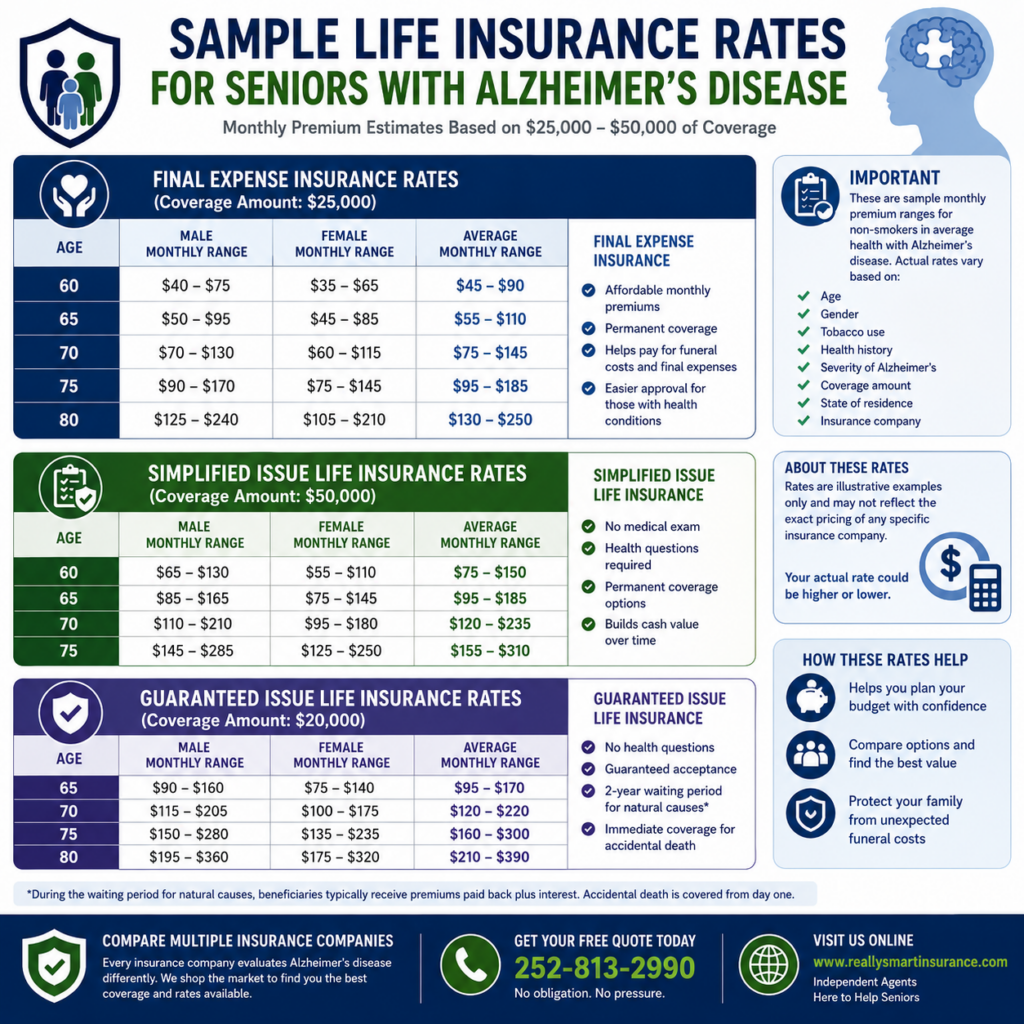
The examples below are educational illustrations only.
Actual premiums vary based on:
- Age
- Gender
- Tobacco use
- Health history
- Severity of Alzheimer’s disease
- Coverage amount
- State of residence
Sample Final Expense Rates
| Age | Coverage | Estimated Monthly Premium |
|---|---|---|
| 60 | $25,000 | $45-$90 |
| 65 | $25,000 | $55-$110 |
| 70 | $25,000 | $75-$145 |
| 75 | $25,000 | $95-$185 |
| 80 | $25,000 | $130-$250 |
Sample Simplified Issue Rates
| Age | Coverage | Estimated Monthly Premium |
|---|---|---|
| 60 | $50,000 | $75-$150 |
| 65 | $50,000 | $95-$185 |
| 70 | $50,000 | $120-$235 |
| 75 | $50,000 | $155-$310 |
Sample Guaranteed Issue Rates
| Age | Coverage | Estimated Monthly Premium |
|---|---|---|
| 65 | $20,000 | $95-$170 |
| 70 | $20,000 | $120-$220 |
| 75 | $20,000 | $160-$300 |
| 80 | $20,000 | $210-$390 |
Can You Buy Life Insurance for Seniors with Alzheimer’s as a child?
One of the most common questions families ask is whether an adult child can purchase life insurance for a parent who has Alzheimer’s disease.
The answer is often yes, but several requirements must be met.
Insurance companies generally require:
- The parent’s knowledge and consent
- Proof of insurable interest
- Signed application documents
- Verification of identity
In the early stages of Alzheimer’s disease, obtaining consent is often straightforward.
As the disease progresses, obtaining new life insurance coverage becomes more challenging because insurance companies must ensure the applicant understands the transaction and can legally consent.
For this reason, families often benefit from exploring coverage options sooner rather than later.
Alzheimer’s Disease and Dementia
Many people use the terms Alzheimer’s disease and dementia interchangeably, but they are not the same thing.
Dementia is a broad term describing symptoms affecting memory, thinking, and reasoning.
Alzheimer’s disease is the most common cause of dementia.
Insurance companies often evaluate:
- Specific diagnosis
- Severity of symptoms
- Progression rate
- Cognitive testing results
- Independence level
Applicants with mild cognitive impairment or very early dementia may have more coverage options than those with advanced disease.
Alzheimer’s Disease and Parkinson’s Disease
Some seniors experience both Alzheimer’s disease and Parkinson’s disease.
When multiple neurological conditions are present, insurance companies may evaluate:
- Mobility limitations
- Cognitive decline
- Fall risk
- Medication use
- Activities of daily living
The combination of conditions often increases underwriting concerns, but final expense and guaranteed issue coverage may remain available.
Alzheimer’s Disease and Stroke History
Previous strokes can contribute to cognitive decline and dementia symptoms.
Insurance companies frequently review:
- Date of stroke
- Recovery status
- Neurological deficits
- Rehabilitation history
- Current cognitive functioning
Applicants with stable health and strong recovery often have more options available than those with ongoing neurological complications.
Alzheimer’s Disease and Heart Disease
Heart disease and Alzheimer’s disease often occur together in older adults.
Insurance companies may review:
- Coronary artery disease
- Heart attack history
- Congestive heart failure
- Blood pressure control
- Cholesterol levels
Because cardiovascular health plays a significant role in life expectancy, heart disease may affect underwriting as much as Alzheimer’s itself.
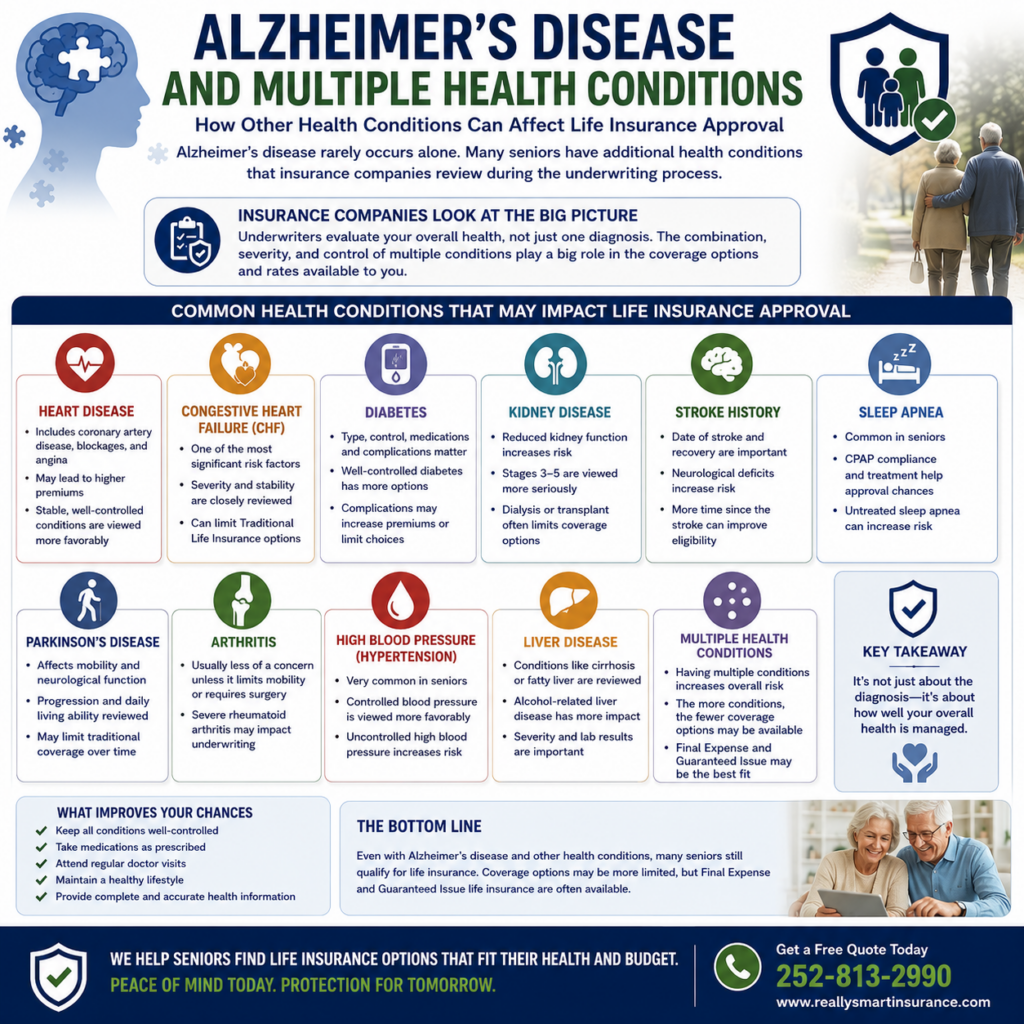
Alzheimer’s Disease and Multiple Health Conditions
Many seniors diagnosed with Alzheimer’s disease also have:
- Diabetes
- Heart disease
- Kidney disease
- High blood pressure
- Sleep apnea
- Arthritis
- Parkinson’s disease
Insurance companies evaluate the entire health profile rather than focusing on a single diagnosis.
For many applicants, the combination of conditions has a greater impact on underwriting than Alzheimer’s disease alone.
Assisted Living, Nursing Homes, and Life Insurance
Families are often surprised to learn that living arrangements can affect life insurance eligibility.
Insurance companies may ask:
- Does the applicant live independently?
- Are they receiving home health care?
- Do they reside in assisted living?
- Are they living in a skilled nursing facility?
Applicants living independently often have more options available.
Those residing in nursing homes may find guaranteed issue life insurance to be the most practical solution.
Real-Life Example
A daughter contacted us after her 72-year-old mother was diagnosed with early-stage Alzheimer’s disease.
The family was worried because they had delayed purchasing coverage and feared they had missed their opportunity.
Her mother’s health profile included:
- Early-stage Alzheimer’s disease
- Controlled blood pressure
- No history of stroke
- No heart disease
- Independent living
Several insurance companies declined to offer traditional coverage.
However, after comparing multiple carriers, we found a final expense policy that provided immediate protection and affordable premiums.
The family gained peace of mind knowing funeral expenses and final costs would not become a burden for surviving loved ones.
The lesson is simple:
A diagnosis does not always mean coverage is impossible.
The right insurance company can make a significant difference.
Frequently Asked Questions
Can someone with Alzheimer’s disease get life insurance?
Yes. Depending on severity and overall health, many seniors can still qualify for final expense, simplified issue, or guaranteed issue life insurance.
What is the easiest policy to qualify for?
Guaranteed issue and final expense life insurance are often the easiest options.
Can a person with dementia buy life insurance?
Sometimes. Eligibility depends on diagnosis, cognitive ability, and the ability to provide informed consent.
Is Alzheimer’s considered a pre-existing condition?
Yes. Insurance companies review Alzheimer’s disease as part of the underwriting process.
Does Alzheimer’s automatically cause a denial?
No. While traditional coverage may be difficult, many seniors still qualify for other policy types.
Can I get life insurance if my parent lives in assisted living?
Possibly. Some insurers still offer coverage depending on health status and facility type.
Can life insurance pay for funeral expenses?
Yes. Beneficiaries may use the death benefit for funeral costs, medical bills, debts, or any other purpose.
Get Life Insurance Quotes for Alzheimer’s Disease Today
If you or a loved one has been diagnosed with Alzheimer’s disease, don’t assume life insurance is no longer an option.
Many families are surprised to learn that coverage may still be available, particularly through final expense insurance, simplified issue life insurance, or guaranteed issue policies.
The challenge is finding the right insurance company.
Every carrier evaluates Alzheimer’s disease differently. While one company may decline an application, another may offer affordable coverage options that provide valuable financial protection for your family.
That’s why Rob and Tracy Pinner compare multiple insurance companies on your behalf.
We Can Help You Compare:
✅ Final Expense Insurance
✅ Simplified Issue Life Insurance
✅ Guaranteed Issue Life Insurance
✅ No Medical Exam Life Insurance
✅ Whole Life Insurance Options
We Frequently Help Seniors With:
- Alzheimer’s Disease
- Dementia
- Parkinson’s Disease
- Stroke History
- Heart Disease
- Congestive Heart Failure
- Kidney Disease
- Diabetes
- Neuropathy
- Sleep Apnea
- Arthritis
- Multiple Health Conditions
Whether you’re planning ahead for yourself or helping a parent explore coverage options, we’re here to help.
Get Your Free Alzheimer’s Life Insurance Quote Today
Call 252-813-2990 or visit www.reallysmartinsurance.com to compare your options.
No obligation. No pressure. Just honest guidance from independent agents who specialize in helping seniors find life insurance coverage.

Why Trust Really Smart Insurance?
Really Smart Insurance specializes in helping seniors compare life insurance options across multiple insurance companies.
We understand that medical conditions such as Alzheimer’s disease can make finding coverage feel overwhelming.
That’s why we work with multiple carriers and help families identify companies that may offer better approval opportunities based on an applicant’s unique health profile.
As independent agents, we are not limited to a single insurance company.
Instead, we compare multiple insurers to help seniors find coverage that fits their needs, budget, and health situation.
Our goal is simple:
Help seniors and their families make informed decisions and find life insurance solutions that provide peace of mind.
Final Thoughts
An Alzheimer’s disease diagnosis can create uncertainty for both seniors and their families.
Many people incorrectly assume that life insurance is no longer available once memory loss or cognitive decline begins.
While traditional life insurance may become more difficult to obtain as Alzheimer’s progresses, many seniors still have options.
Final expense insurance, simplified issue policies, and guaranteed issue life insurance can provide valuable financial protection and help ensure loved ones are not left with unexpected funeral expenses or final bills.
The most important step is exploring your options as early as possible.
The earlier coverage is secured, the more choices are typically available.
If you or a loved one has Alzheimer’s disease, comparing multiple insurance companies may help uncover opportunities that you didn’t realize existed.
With the right guidance and the right insurance company, many families find solutions that provide both protection and peace of mind.