Life Insurance for Seniors With Neuropathy: Approval Tips, Rates & Best Companies (2026 Guide)
 Posted in Senior Life Insurance on June 11, 2026 last updated on June 11, 2026
Is Life Insurance for Seniors With Neuropathy Possible?
Yes, many seniors with neuropathy can still qualify for life insurance.
However, approval opportunities and pricing often depend on the cause of the neuropathy, symptom severity, mobility limitations, medications, and overall health.
Many applicants assume that nerve damage automatically prevents them from obtaining affordable coverage. Fortunately, that is usually not the case.
Insurance companies typically focus less on the neuropathy diagnosis itself and more on the underlying condition causing it.
For example, neuropathy caused by well-controlled diabetes may receive different underwriting consideration than neuropathy caused by kidney disease, a previous stroke, or another neurological disorder.
Depending on your health profile, available options may include:
- Traditional life insurance
- Term life insurance
- Whole life insurance
- No medical exam life insurance
- Simplified issue life insurance
- Final expense insurance
- Guaranteed issue life insurance
The best option depends on your age, health history, mobility, and overall medical profile.
Quick Answer
If you’re looking for the short version:
- Many seniors with neuropathy qualify for life insurance.
- Mild neuropathy often has minimal underwriting impact.
- Insurance companies focus heavily on the underlying cause.
- Diabetic neuropathy receives special attention.
- Mobility limitations may affect approval chances.
- Traditional coverage may still be available.
- Final expense and guaranteed issue options remain available for more severe cases.
What Is Neuropathy?
According to WebMd, neuropathy refers to nerve damage that affects communication between the brain, spinal cord, and other parts of the body.
The condition most commonly affects the:
- Feet
- Legs
- Hands
- Arms
Symptoms may include:
- Numbness
- Tingling
- Burning sensations
- Pain
- Muscle weakness
- Loss of balance
- Difficulty walking
Neuropathy is not a disease itself.
Instead, it is usually a symptom of another underlying medical condition.
Because of this, life insurance companies often focus on what caused the neuropathy rather than the neuropathy alone.
Types of Neuropathy Insurance Companies Review
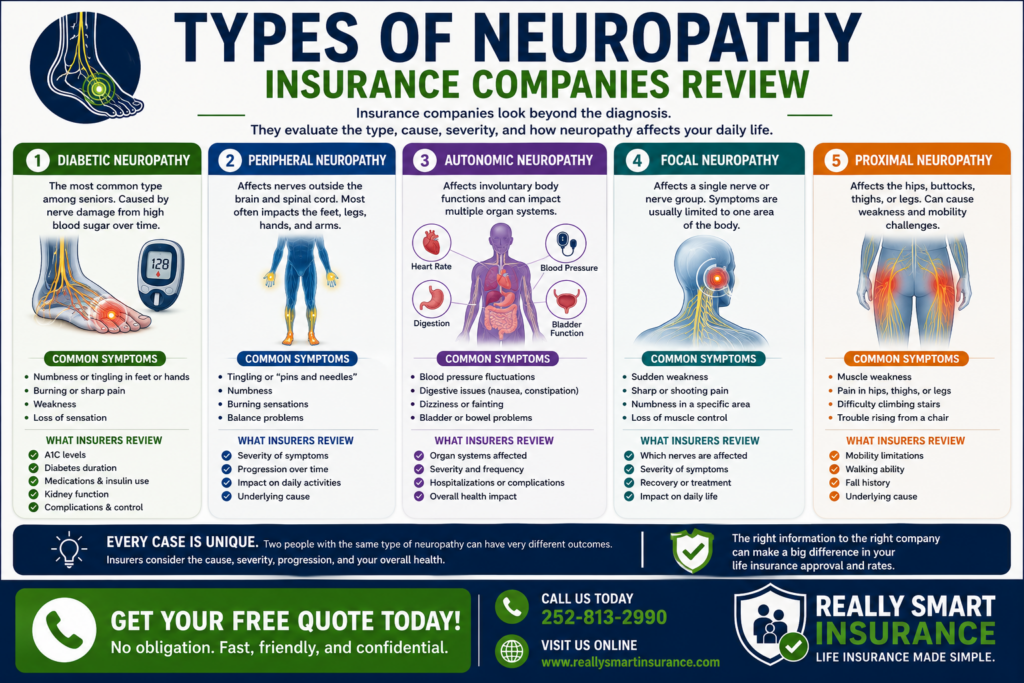
Not all neuropathy is the same.
One of the first things insurance companies evaluate is the type of neuropathy you have and the medical condition causing it.
Diabetic Neuropathy
Diabetic neuropathy is the most common form of neuropathy among seniors.
It develops when elevated blood sugar levels damage nerves over time.
Insurance companies often review:
- A1C levels
- Diabetes duration
- Insulin use
- Kidney function
- Diabetic complications
- Medication history
In many cases, insurers place greater emphasis on diabetes control than the neuropathy itself.
Peripheral Neuropathy
Peripheral neuropathy affects nerves outside the brain and spinal cord and commonly impacts the feet, legs, hands, and arms.
Symptoms may include:
- Tingling
- Numbness
- Burning sensations
- Weakness
- Balance problems
Mild peripheral neuropathy often receives favorable underwriting consideration.
Autonomic Neuropathy
Autonomic neuropathy affects involuntary body functions.
Insurance companies may evaluate:
- Blood pressure fluctuations
- Digestive problems
- Heart rate abnormalities
- Bladder function
Because autonomic neuropathy can affect multiple organ systems, it often receives additional underwriting review.
Focal Neuropathy
Focal neuropathy affects a single nerve or nerve group.
Symptoms may be limited to one area of the body.
When symptoms are mild and localized, underwriting outcomes are often favorable.
Proximal Neuropathy
Proximal neuropathy most commonly affects the hips, thighs, buttocks, and legs.
Insurance companies may review:
- Mobility limitations
- Muscle weakness
- Walking ability
- Fall history
Severity plays a major role in underwriting decisions.
Common Causes of Neuropathy
Diabetic Neuropathy
The most common form among seniors.
Insurance companies may review:
- A1C levels
- Diabetes duration
- Medications
- Complications
- Kidney function
Peripheral Neuropathy
Peripheral neuropathy affects nerves outside the brain and spinal cord.
Severity varies considerably.
Neuropathy From Kidney Disease
Kidney disease can contribute to nerve damage.
Insurance companies often evaluate:
- Kidney function
- GFR levels
- Dialysis history
- Stage of kidney disease
Neuropathy After Stroke
Some stroke survivors experience nerve damage and mobility limitations.
Insurance companies often review:
- Recovery status
- Rehabilitation progress
- Ongoing symptoms
Alcohol-Related Neuropathy
Underwriters may evaluate:
- Alcohol history
- Liver function
- Current treatment status
Idiopathic Neuropathy
Sometimes no clear cause is identified.
When symptoms remain mild and stable, underwriting may be more favorable.
How Life Insurance Companies Evaluate Neuropathy
Insurance companies generally focus on five major areas.
Underlying Cause
This is often the most important factor.
Neuropathy caused by well-controlled diabetes may receive very different underwriting treatment than neuropathy caused by advanced kidney disease or neurological disorders.
Severity
Insurance companies often ask:
- Is the neuropathy mild, moderate, or severe?
- Is it progressing?
- Is it stable?
Mobility
Mobility plays a significant role.
Underwriters may review:
- Walking ability
- Use of a cane
- Use of a walker
- Fall history
- Ability to perform daily activities
Medications
Common medications include:
- Gabapentin
- Pregabalin (Lyrica)
- Duloxetine
- Amitriptyline
Medication history often provides insight into symptom severity.
Other Medical Conditions
Neuropathy frequently occurs alongside:
- Diabetes
- Heart disease
- Kidney disease
- Obesity
- Sleep apnea
- Stroke history
Insurance companies evaluate the complete health profile rather than a single diagnosis.
How Mobility Limitations Affect Life Insurance Approval
For many seniors with neuropathy, mobility may have a greater impact on underwriting than the diagnosis itself.
Insurance companies frequently evaluate:
- Ability to walk independently
- Use of a cane
- Use of a walker
- Fall history
- Ability to perform daily activities
- Overall independence
Mild Mobility Limitations
Characteristics may include:
- Occasional balance concerns
- Minor numbness
- Independent walking
Life Insurance Outlook
Many applicants still qualify for traditional life insurance coverage.
Moderate Mobility Limitations
Characteristics may include:
- Frequent balance issues
- Use of a cane
- Difficulty walking long distances
Life Insurance Outlook
Coverage is often available, although premiums may be higher.
Severe Mobility Limitations
Characteristics may include:
- Frequent falls
- Walker use
- Significant weakness
- Assistance with daily activities
Life Insurance Outlook
Traditional underwriting becomes more challenging, and simplified issue or guaranteed issue policies may offer better approval opportunities.
Neuropathy Severity Levels and Life Insurance Approval Chances
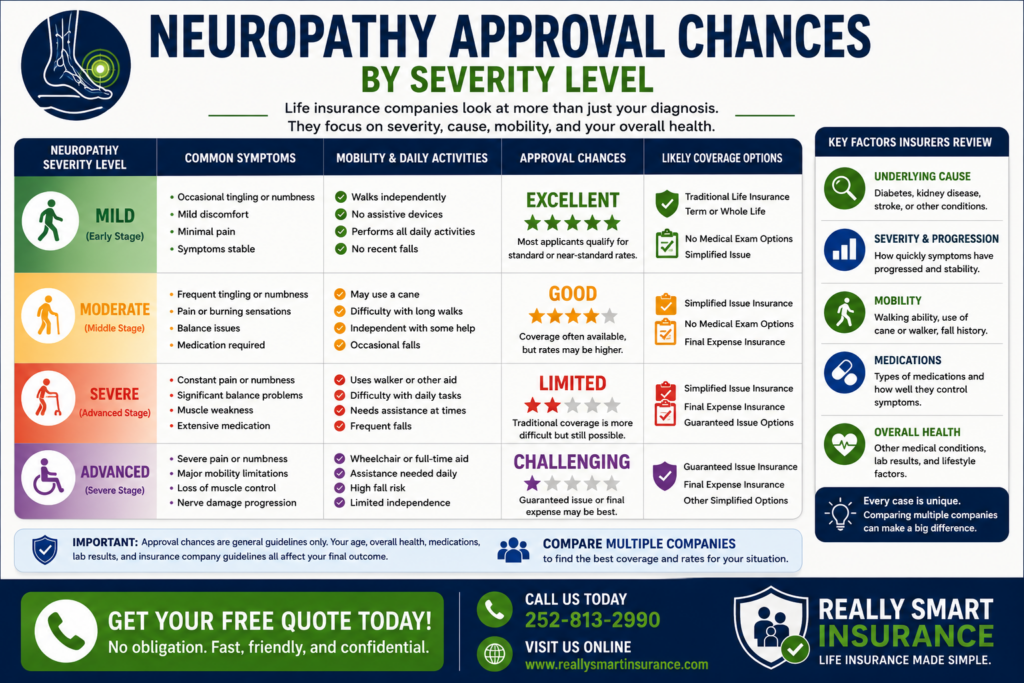
Mild Neuropathy
Characteristics may include:
- Occasional numbness
- Mild tingling
- Minimal pain
- No mobility limitations
Life Insurance Outlook
Many applicants qualify for traditional life insurance and may receive standard or near-standard rates.
Moderate Neuropathy
Characteristics may include:
- Frequent symptoms
- Medication use
- Some balance concerns
- Occasional mobility limitations
Life Insurance Outlook
Coverage is often available, although rates may be higher.
Severe Neuropathy
Characteristics may include:
- Significant pain
- Walking difficulties
- Frequent falls
- Extensive medication use
Life Insurance Outlook
Traditional underwriting becomes more challenging. Simplified issue and final expense policies often become more attractive options.
Advanced Neuropathy
Characteristics may include:
- Major mobility limitations
- Assistive devices
- Significant disability
Life Insurance Outlook
Guaranteed issue and final expense insurance may provide the best opportunities.
Neuropathy, Foot Ulcers, and Amputations
One of the most important concerns for insurance companies evaluating diabetic neuropathy is the presence of foot ulcers or amputations.
Underwriters frequently ask:
- Have you experienced diabetic foot ulcers?
- Have you had recurring infections?
- Have you required hospitalization?
- Have you undergone a toe amputation?
- Have you undergone a partial foot amputation?
Foot ulcers can indicate advanced diabetic complications and may significantly impact underwriting decisions.
However, many seniors with a history of healed ulcers or minor amputations still qualify for coverage.
Insurance companies often review:
- Date of occurrence
- Healing status
- Current mobility
- Diabetes control
- Overall health profile
Every case is unique, and approval opportunities vary from company to company.
Neuropathy Severity and Coverage Options
| Severity | Traditional Life Insurance | Simplified Issue | Guaranteed Issue |
|---|---|---|---|
| Mild | Excellent | Available | Available |
| Moderate | Good | Excellent | Available |
| Severe | Limited | Good | Excellent |
| Advanced | Rare | Limited | Excellent |
This table is a great candidate for a featured snippet and should stay near the middle of the article.
What Underwriting Class Can You Qualify For With Neuropathy?
Preferred
Possible when:
- Mild symptoms
- No diabetes complications
- Excellent overall health
Standard
Common for:
- Mild to moderate neuropathy
- Stable symptoms
- Good mobility
Table Rated
Common for:
- Diabetic neuropathy
- Multiple health conditions
- Mobility concerns
Simplified Issue
Often available for:
- Moderate neuropathy
- Seniors seeking faster approval
Guaranteed Issue
Often considered when:
- Traditional underwriting is unavailable
- Severe mobility limitations exist
- Multiple serious conditions are present
Best Life Insurance Options for Seniors With Neuropathy
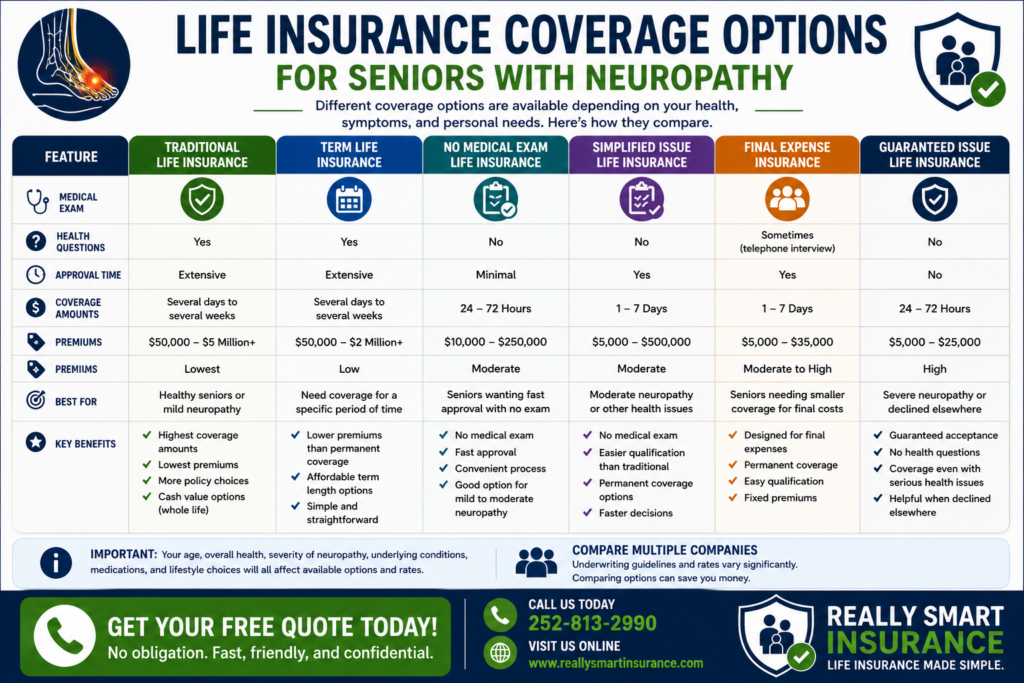
Traditional Life Insurance
Many seniors with mild or moderate neuropathy still qualify for traditional life insurance coverage.
Advantages:
- Higher coverage amounts
- Lower premiums
- More policy choices
- Potential cash value accumulation with whole life policies
Best For:
- Mild neuropathy
- Stable symptoms
- Good overall health
- Minimal mobility limitations
No Medical Exam Life Insurance
Many insurance companies now offer policies that do not require bloodwork or a medical exam.
Advantages:
- Faster approval
- No physical exam
- Simplified underwriting
- Convenient application process
Best For:
- Mild to moderate neuropathy
- Seniors seeking faster approvals
- Applicants wanting to avoid paramed exams
Simplified Issue Life Insurance
These policies typically require health questions but no medical exam.
Advantages:
- Easier qualification
- Faster decisions
- Permanent coverage options
Best For:
- Moderate neuropathy
- Diabetic neuropathy
- Multiple health conditions
Final Expense Insurance
Final expense insurance is often one of the easiest coverage options to obtain.
Advantages:
- Permanent protection
- Fixed premiums
- Easier underwriting
- Coverage for funeral and burial expenses
Best For:
- Moderate to severe neuropathy
- Seniors ages 50-85
- Applicants needing smaller coverage amounts
Guaranteed Issue Life Insurance
Guaranteed issue policies accept nearly everyone.
Advantages:
- No health questions
- No medical exam
- Guaranteed acceptance
Disadvantages:
- Higher premiums
- Lower death benefits
- Waiting periods often apply
Best Life Insurance Companies for Seniors With Neuropathy
Not every company evaluates neuropathy the same way.
Some carriers place greater emphasis on the underlying cause, while others focus primarily on overall health and mobility.
Mutual of Omaha
Best For:
- Final expense coverage
- Seniors ages 50-85
- Moderate health conditions
Foresters Financial
Best For:
- Simplified issue coverage
- Faster approvals
- Multiple health conditions
Americo
Best For:
- Diabetic neuropathy
- Final expense insurance
- Flexible underwriting
Prudential
Best For:
- Mild neuropathy
- Larger coverage amounts
- Traditional underwriting
Protective
Best For:
- Strong overall health
- Competitive rates
- Term life insurance
Corebridge Financial (AIG)
Best For:
- Guaranteed issue coverage
- Severe neuropathy
- Applicants declined elsewhere
Best Life Insurance Companies Table ⭐
| Company | Best For |
|---|---|
| Mutual of Omaha | Final Expense |
| Foresters | Simplified Issue |
| Americo | Diabetic Neuropathy |
| Prudential | Mild Neuropathy |
| Protective | Larger Coverage |
| Corebridge | Guaranteed Issue |
Sample Life Insurance Rates for Seniors With Neuropathy
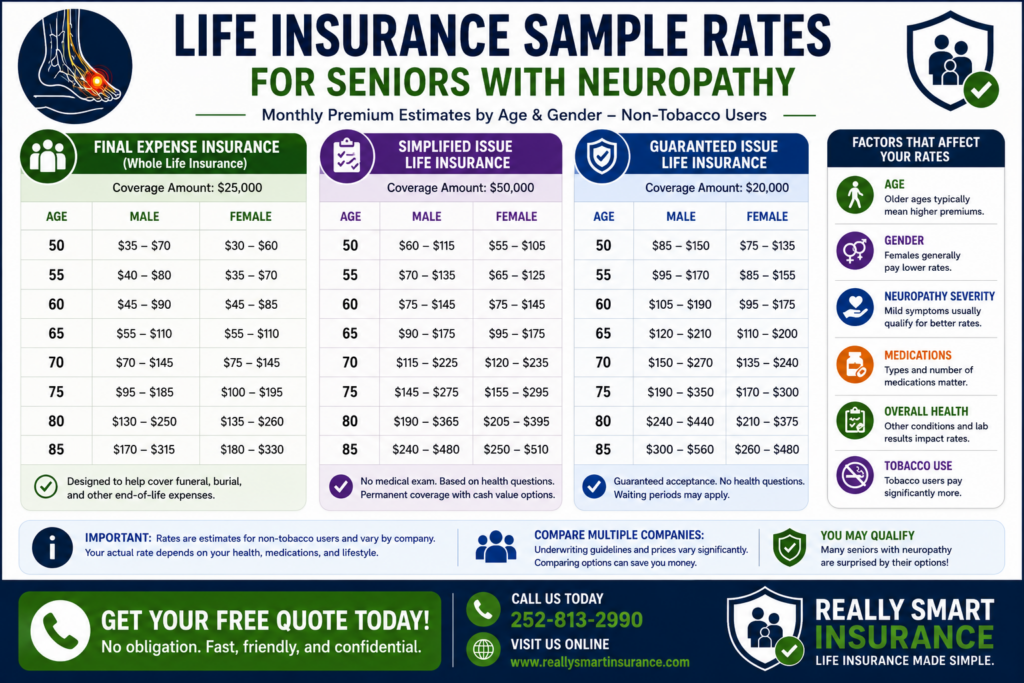
The examples below are educational illustrations only.
Actual premiums vary based on:
- Age
- Gender
- Tobacco use
- Underlying medical conditions
- Neuropathy severity
- State of residence
Sample Final Expense Rates
| Age | Coverage | Estimated Monthly Premium |
|---|---|---|
| 60 | $25,000 | $45-$90 |
| 65 | $25,000 | $55-$110 |
| 70 | $25,000 | $70-$145 |
| 75 | $25,000 | $95-$185 |
| 80 | $25,000 | $130-$250 |
Sample Simplified Issue Rates
| Age | Coverage | Estimated Monthly Premium |
|---|---|---|
| 60 | $50,000 | $75-$145 |
| 65 | $50,000 | $90-$175 |
| 70 | $50,000 | $115-$225 |
| 75 | $50,000 | $145-$295 |
Sample Guaranteed Issue Rates
| Age | Coverage | Estimated Monthly Premium |
|---|---|---|
| 65 | $20,000 | $95-$170 |
| 70 | $20,000 | $120-$210 |
| 75 | $20,000 | $150-$280 |
| 80 | $20,000 | $190-$350 |
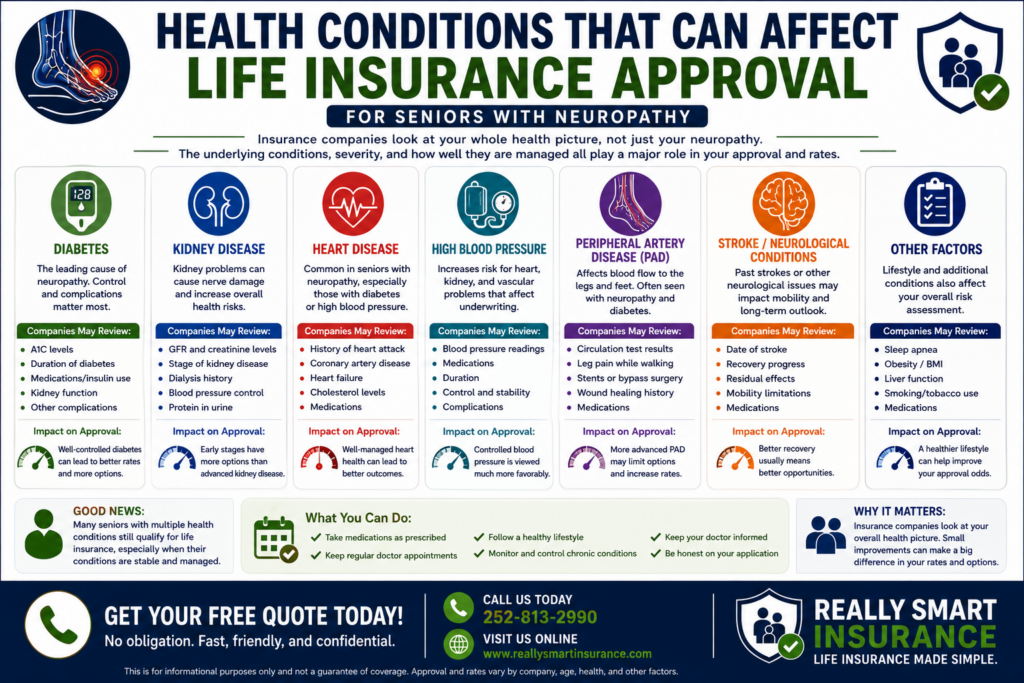
Neuropathy and Diabetes
Diabetes is the leading cause of neuropathy among seniors.
Insurance companies frequently review:
- A1C levels
- Diabetes duration
- Insulin use
- Kidney function
- Diabetic complications
- Neuropathy progression
In many cases, underwriters focus more heavily on diabetes control than neuropathy itself.
Applicants with well-controlled diabetes often receive significantly better offers than those with poorly controlled blood sugar levels.
Neuropathy and Kidney Disease
Kidney disease is another common cause of nerve damage.
Insurance companies may review:
- Stage of kidney disease
- GFR levels
- Creatinine levels
- Dialysis history
- Blood pressure control
When kidney disease is present, underwriting decisions are often driven more by kidney function than neuropathy symptoms.
Applicants with early-stage kidney disease generally have more options available than those requiring dialysis.
Neuropathy and Heart Disease
Heart disease frequently occurs alongside neuropathy, especially in diabetic applicants.
Insurance companies may evaluate:
- Previous heart attacks
- Coronary artery disease
- Cholesterol levels
- Blood pressure control
- Heart failure history
Because cardiovascular health significantly impacts mortality risk, heart disease often carries more underwriting weight than neuropathy itself.
Neuropathy and Sleep Apnea
Sleep apnea commonly occurs alongside diabetes, obesity, and neuropathy.
Insurance companies often review:
- CPAP compliance
- Sleep study results
- Oxygen levels
- Overall cardiovascular health
Well-controlled sleep apnea generally receives more favorable underwriting treatment than untreated sleep apnea.
Neuropathy and Obesity
Obesity frequently contributes to both diabetes and neuropathy.
Insurance companies may evaluate:
- BMI
- Mobility limitations
- Blood pressure
- Cholesterol levels
- Diabetes control
Many seniors with obesity and neuropathy still qualify for life insurance, particularly when their overall health remains stable.
Neuropathy and Multiple Health Conditions
Many seniors with neuropathy also have multiple health conditions such as:
- Diabetes
- Heart disease
- High blood pressure
- Kidney disease
- Sleep apnea
- Obesity
Insurance companies evaluate the entire health picture rather than focusing on a single diagnosis.
For many applicants, the combination of conditions affects underwriting more than neuropathy itself.
Neuropathy and Peripheral Artery Disease (PAD)
Peripheral artery disease (PAD) frequently occurs alongside neuropathy, particularly among seniors with diabetes.
PAD reduces blood flow to the legs and feet and may contribute to:
- Leg pain
- Poor circulation
- Slow wound healing
- Increased risk of ulcers
- Mobility limitations
Insurance companies often evaluate:
- PAD severity
- Vascular procedures
- Stent history
- Bypass surgery
- Circulation test results
- Walking ability
In many cases, PAD may have a larger impact on underwriting than neuropathy itself.
Applicants with mild, well-managed PAD often have more coverage options than those with advanced vascular disease.
Neuropathy and Stroke
Some seniors develop neuropathy following a stroke, while others experience both conditions independently.
Insurance companies may review:
- Date of stroke
- Recovery progress
- Rehabilitation history
- Residual weakness
- Mobility limitations
- Current neurological status
Many applicants recover well and continue to qualify for life insurance coverage.
The overall severity of lingering symptoms often has a greater impact on underwriting than the stroke diagnosis itself.
Real-Life Example
A 68-year-old applicant contacted us after being declined for life insurance due to concerns about diabetic neuropathy.
His health profile included:
- Type 2 diabetes
- Mild neuropathy in both feet
- Controlled blood pressure
- No history of stroke
- No heart disease
- Non-smoker
He assumed that the decline meant life insurance was no longer an option.
After reviewing his medical records, we found several positive factors:
- Stable A1C levels
- No kidney complications
- Independent mobility
- Consistent medication compliance
- No recent hospitalizations
Rather than applying with the same company again, we compared multiple carriers.
Several insurers viewed his overall health much more favorably.
Ultimately, he was approved for coverage that protected his family while fitting comfortably within his budget.
The lesson is simple:
A neuropathy diagnosis alone does not determine your life insurance outcome.
The right insurance company can make a significant difference.

Helpful Resources
You may also find these guides helpful:
Frequently Asked Questions
Can you get life insurance if you have neuropathy?
Yes. Many seniors with neuropathy qualify for life insurance. Approval depends on severity, underlying cause, mobility, and overall health.
Does neuropathy increase life insurance rates?
Sometimes. Mild neuropathy may have little impact, while severe neuropathy or significant underlying conditions can increase premiums.
Is diabetic neuropathy harder to insure?
In some cases. Insurance companies closely evaluate diabetes control, complications, and long-term health outcomes.
Can I get life insurance without a medical exam?
Yes. Many seniors with neuropathy qualify for no medical exam or simplified issue coverage.
What is the easiest policy to qualify for?
Final expense and guaranteed issue life insurance are often the easiest options.
Can I qualify if I use a cane or walker?
Possibly. Insurance companies evaluate mobility limitations individually.
Can I get life insurance after being declined?
Yes. Different companies have different underwriting guidelines. A decline from one insurer does not necessarily mean another company will decline your application.
Get Personalized Life Insurance Quotes — Even With Neuropathy
Having neuropathy does not automatically prevent you from getting life insurance.
Many seniors are surprised to learn they still qualify for affordable coverage, even with diabetic neuropathy, peripheral neuropathy, mobility concerns, or multiple health conditions.
The key is finding the right insurance company.
Every insurer evaluates neuropathy differently. One company may decline an application while another may offer competitive coverage options.
That’s why Rob and Tracy Pinner compare multiple life insurance companies on your behalf.
We Can Help You Compare:
✅ Traditional Life Insurance
✅ No Medical Exam Life Insurance
✅ Simplified Issue Life Insurance
✅ Final Expense Insurance
✅ Guaranteed Issue Life Insurance
Get Help If You Have:
- Diabetic Neuropathy
- Peripheral Neuropathy
- Kidney Disease
- Heart Disease
- Sleep Apnea
- Obesity
- Diabetes
- Multiple Health Conditions
Don’t assume you have run out of options.
Request a personalized quote today and discover which companies may offer the best rates and approval opportunities for your specific health profile.
Get Your Free Life Insurance Quote Today

Why Trust Really Smart Insurance?
Really Smart Insurance specializes in helping seniors compare life insurance options across multiple insurance companies.
We regularly assist applicants with:
- Diabetes
- Neuropathy
- Kidney Disease
- Heart Disease
- Sleep Apnea
- High Blood Pressure
- Obesity
- Multiple Health Conditions
Because we are independent agents, we can compare multiple carriers to help identify companies that may offer better rates and approval opportunities based on your unique health history.
Final Thoughts
Neuropathy can be frustrating and sometimes debilitating, but it does not automatically eliminate your life insurance options.
Many seniors with mild to moderate neuropathy still qualify for affordable coverage, especially when the underlying condition is well managed.
The key is understanding how insurance companies evaluate neuropathy, comparing multiple carriers, and choosing the policy that best fits your needs.
With the right guidance, many applicants discover they have far more options than they expected.